

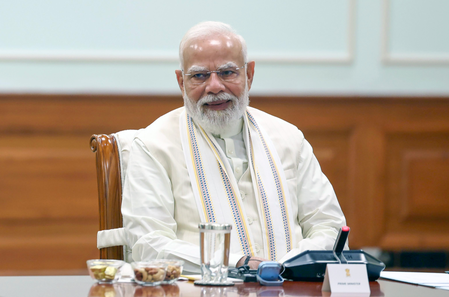
‘India brought back 650 stolen idols in 12 years’
New Delhi, Oct 23: Prime Minister Narendra Modi on Friday said India had recovered more than 650 stolen ancient statues over the past 12 years, highlighting efforts to preserve the country’s cultural heritage, and called for unity against divisive forces, greater self-reliance and collective efforts to realise the vision of a developed India by 2047.
Addressing the Chinmaya Amrit Mahotsav Global Sammelan in New Delhi, Modi said new challenges had emerged over the past decades and the responsibility to address social distortions rested with everyone.
“Today, we have to unite society against the divisive forces. We must awaken our citizens to the need for self-reliance. We must connect every citizen with the resolve for a developed India in 2047. We must become more active towards these objectives,” he said.
The Prime Minister said 2047 would mark 100 years of India’s Independence as well as the centenary of the Chinmaya Mission, describing both milestones as an opportunity to work together towards shared goals.
Highlighting the importance of preserving India’s cultural and spiritual heritage, Modi said conservation of Indian heritage was one of the missions of Swami Chinmayananda, founder of the Chinmaya Mission.
He cited the recovery of more than 650 stolen ancient statues over the past 12 years, saying many such artefacts had earlier been taken abroad and sold without adequate intervention.
“You all know that there was a time when many statues were stolen and taken to foreign countries. They were sold, and no one stopped them. In the last 12 years, we have brought back more than 650 stolen ancient statues,” he said.
Modi also highlighted the restoration and development of prominent religious and cultural sites, including Kashi Vishwanath Dham, the Ram temple in Ayodhya, and the sacred shrines of Kedarnath and Badrinath.
He said India’s cultural centres were regaining prominence from north to south and east to west. Referring to Kedarnath, he mentioned the installation of a statue of Adi Shankaracharya at the site where the philosopher is believed to have attained his final state of existence.
The Prime Minister also cited International Yoga Day as an example of India’s growing cultural presence globally, saying it was connecting people worldwide with the country’s ancient traditions.
Recalling Swami Chinmayananda’s contributions, Modi said the spiritual leader had devoted his life not only to religious and philosophical teachings but also to raising awareness about India’s cultural heritage and national development. He described Chinmayananda’s life as a confluence of knowledge, action and devotion.
Modi also underscored the importance of young people in nation-building, saying he had consistently kept youth at the centre of government policies. He appreciated the contributions of young volunteers who participated in the Chinmaya Amrit Mahotsav celebrations.
He said a group of young members of the Chinmaya Mission had travelled across the country for 300 days, covering 40,000 kilometres and interacting with more than one lakh young people.
The Prime Minister further highlighted the National Education Policy, saying it was designed to meet the needs of a new India by incorporating traditional knowledge systems, education in the mother tongue, modern science and emerging technologies.
Recalling India’s 75th year of Independence, Modi said the milestone should inspire the vision of a developed nation while reinforcing the country’s civilisational values and enduring ideas.
Referring to the Upanishadic expression ‘Vayam Amritasya Putrah’, meaning “We are the children of immortality”, he said it reflected the eternal nature of consciousness rather than physical immortality.
Modi urged citizens to work collectively towards national development, self-reliance and the preservation of India’s cultural heritage, saying the country’s progress required a shared commitment to these objectives.

