

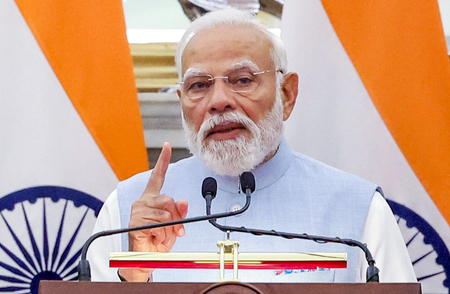
Seeks global mechanism to block cyber threats
New Delhi: Prime Minister Narendra Modi on Thursday called for a global mechanism to prevent cyber fraud and deepfakes from reaching citizens, urging governments, technology companies, telecom operators and financial institutions to work together to tackle increasingly borderless digital crimes.
Addressing the inauguration of the 10th edition of the India Mobile Congress in New Delhi, Modi said cyber fraud and cybercrime had already crossed national boundaries and required a coordinated international response.
“Technology achieves scale only when it earns trust,” the Prime Minister said, stressing that citizens need confidence that phone calls are genuine, messages are authentic, payments are secure and personal information is protected.
Modi said a person sitting in one country could commit a crime in another country with assistance from a third country, highlighting the increasingly international nature of cybercrime. He also identified deepfakes as a serious and growing challenge.
He urged the GSMA and telecom operators around the world to come together to develop a mechanism capable of stopping fraudulent communications before they reach users.
“Governments, technology companies, telecom operators, and financial institutions must all become part of such a framework,” he said, adding that India was prepared to share the experience it had gained in dealing with digital challenges.
The Prime Minister also highlighted India’s rapid expansion of telecom infrastructure, saying 5G connectivity had now reached every district of the country.
More than 550,000 5G base stations are currently operating across India, he said, while mobile internet speeds have increased tenfold compared with 2022, when India launched 5G.
Modi recalled that the India Mobile Congress had tracked the country’s telecom transformation over the past decade. At the 2022 edition, India launched 5G from the IMC platform, while in 2023 the focus shifted from 5G “roll-out” to 5G “reach-out”.
He congratulated the organisers and participants of the 10th edition, saying the event had evolved into a platform showcasing India’s progress and aspirations in telecommunications and digital technology.
Modi said India’s telecom transformation should not be viewed only in terms of networks, spectrum, towers and internet speeds. For ordinary citizens, he said, the mobile phone had become an important instrument of good governance and a central component of the government’s Digital India vision.
He said the objective of expanding connectivity and making mobile technology affordable was to democratise access to technology and prevent digital tools from becoming a privilege available only to those with greater resources.
According to Modi, telecom reforms, infrastructure expansion and domestic manufacturing helped make mobile phones and data more accessible and affordable.
The Prime Minister pointed to the experience of the COVID-19 pandemic as evidence of the importance of India’s digital ecosystem. Despite widespread disruption, he said, offices, banks and educational institutions were able to continue functioning because of mobile and internet connectivity.
Digital connectivity, he said, helped maintain access to education, healthcare, payments and government services, including for people in remote and disadvantaged communities.
Modi cited the government’s DIKSHA digital education platform as an example of the scale of India’s digital transformation.
During the COVID period, by July 2022, DIKSHA had recorded more than 5 billion learning sessions and nearly 600 billion learning minutes, he said.
The government’s current objective, according to Modi, is to connect nearly 250 million students to digital and online education platforms.
He argued that mobile connectivity had helped turn India’s geographic and linguistic diversity from a source of inconvenience into an opportunity for greater access to services and information.
The Prime Minister also highlighted the role of mobile connectivity and digital governance in the delivery of government welfare programmes.
He said nearly Rs 50 lakh crore had reached beneficiaries directly through the Direct Benefit Transfer system.
According to Modi, the system had prevented nearly Rs 5 lakh crore from being lost through leakages and misuse.
He defended the government’s decision to reform the earlier system despite opposition from those who, he said, had benefited from leakages.
Modi said the money now reached its intended beneficiaries and that savings generated by preventing misuse could be directed towards productive purposes.
The Prime Minister also cited the PM-Kisan Samman Nidhi scheme, under which he said more than Rs 4 lakh crore had been transferred directly into farmers’ bank accounts.
The payments are made every four months, he said, with farmers receiving notifications on their mobile phones.
Modi said the system had enabled government assistance to reach millions of small farmers who had previously remained outside the effective reach of government schemes.
He described the resulting benefits in terms of reduced travel, waiting time and costs, calling this a major citizen dividend delivered through technology.
Modi said the expansion of affordable connectivity had also created new economic sectors and opportunities for young Indians.
He cited the gaming industry, saying more than 500 million people in India are now connected to the gaming ecosystem in some form.
Young people, including those from Tier-2 and Tier-3 cities, are increasingly participating in e-sports, producing gaming content and establishing gaming businesses, he said.
The Prime Minister described the mobile phone as having evolved beyond a communications device into both a gaming console and a creation studio.
He similarly pointed to the growth of India’s content economy, saying faster connectivity and affordable data had taken video-sharing platforms, social media and regional OTT services into villages and smaller towns.
According to Modi, this expansion had reduced language-related barriers and helped democratise content creation. He said the content-creation industry was now worth thousands of crores of rupees and provided income opportunities for millions.
Modi said India had progressed from being primarily a consumer of technology to becoming a creator and was now moving towards a model in which products, designs, technology and intellectual property would originate in India.
He said the government was providing incentives and pursuing reforms to support this transition.
The Prime Minister pointed to the Telecommunications Act as part of efforts to modernise India’s regulatory framework and said the government was rationalising structural burdens such as adjusted gross revenue and bank guarantees.
He also cited the GatiShakti Sanchar Portal, saying it had accelerated right-of-way approvals through digital processes.
Modi said India’s semiconductor ecosystem was also gaining momentum, with commercial production having started at five locations.
He said the next phase of the India Semiconductor Mission would focus on developing the entire semiconductor supply chain.
The Prime Minister presented the semiconductor push as part of a broader effort to build domestic capabilities across the telecom and technology ecosystem.
With four years remaining in the decade, Modi said discussions at the 10th India Mobile Congress should help shape a roadmap not only for India but also for the global mobile market.
He said the next phase of India’s technology journey should focus on partnerships, research, products, investment and innovation rather than simply showcasing technologies.
Modi called for the India Mobile Congress to evolve into a platform connecting technology, research, industry, investment and ideas.
He said the event should ultimately be remembered for partnerships formed, research projects launched, products taken to global markets and innovations emerging from India for the benefit of humanity.
The Prime Minister also referred to his completion of 25 years as Head of Government, describing the period as a continuous journey of public service.
He thanked citizens of India and friends of India around the world for their greetings and good wishes.
The occasion also coincided with the 10th anniversary of the India Mobile Congress and India’s hosting of the GSMA Board meeting, which brought telecom operators, industry leaders, experts, academics and startups from around the world to the event.
At the beginning of his address, Modi paid tribute to veteran actor Nana Patekar, referring to news of his death received earlier in the day.
He described Patekar as an outstanding artist who had won audiences through a wide range of roles and said the actor had devoted his life to the honour and glory of the Tricolour.
Modi also praised Patekar’s work addressing social disorder and injustice through cinema and offered condolences to his family, admirers and followers.
Modi’s address placed digital trust and cybersecurity alongside connectivity and technological expansion as central challenges for India’s next phase of digital development.
While highlighting the scale of India’s 5G rollout, digital payments, online education and domestic technology manufacturing, the Prime Minister argued that technological expansion would have limited value without public confidence in the security and authenticity of digital interactions.
His call for a global framework against cyber fraud and deepfakes emerged as the central international proposal of the address.
With cybercrime increasingly operating across borders, Modi’s appeal to the GSMA, telecom operators, technology companies, governments and financial institutions signals an emphasis on preventing fraudulent activity before citizens are targeted, rather than relying solely on action after victims have already been affected.
The Prime Minister said India was ready to share its experience with the international community as the country seeks to move from being a major consumer of digital technology towards becoming a producer of technology, intellectual property and globally relevant digital solutions.

