

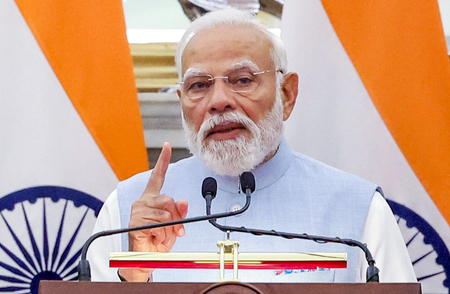
Notes infra growth since 2019; unveils Rs 3,350-cr projects
Leh: Prime Minister Narendra Modi on Thursday virtually inaugurated five major development projects worth around Rs 3,350 crore in Ladakh, describing the occasion as a historic milestone and saying the initiatives would strengthen connectivity, improve electricity and water availability, boost tourism and preserve the region’s rich cultural heritage.
Addressing a gathering through video conferencing, Modi said a new chapter was being written in Ladakh’s history and development. Greeting the people in the Ladakhi language, he congratulated residents, engineers and all those associated with the projects, making a special mention of the Border Roads Organisation (BRO).
Recalling the snowfall in Zanskar, he said he had seen people proudly holding the Tricolour high despite the weather. “This is our Ladakh,” he said, expressing happiness at being part of the region’s development milestone.
The Prime Minister said the projects would make travel easier, improve electricity facilities, increase water availability and strengthen the preservation of Ladakh’s ancient heritage.
A major highlight was the dedication of the 298-km Nimmu-Padum-Darcha Road, constructed by the BRO at a cost of around Rs 2,500 crore.
Connecting Nimmu in Leh with Darcha in Himachal Pradesh through the remote Zanskar Valley, the road provides an alternative connectivity corridor to Ladakh, supplementing the Srinagar-Leh and Manali-Leh highways.
Modi said the road would reduce travel time from around 12 hours to just three hours, adding that it would boost travel and trade in the coming years.
He praised the BRO and other personnel associated with the project, acknowledging their contribution to infrastructure development in the challenging Himalayan terrain.
The Prime Minister inaugurated the new passenger terminal building at Kushok Bakula Rimpochee Airport in Leh, built at a cost of around Rs 640-650 crore.
Spread over 23,800 square metres, the modern terminal is designed to handle 35 lakh passengers annually, against the existing capacity of around 10 lakh. Modi said the airport’s passenger-handling capacity would increase substantially and flight operations would rise threefold.
The terminal incorporates geothermal technology to improve energy efficiency and reduce its carbon footprint, making it the first airport in the country to have this facility, according to the Prime Minister.
Recalling that he had earlier laid the foundation stone for the new terminal, Modi said its inauguration reflected the Centre’s commitment to Ladakh’s development. He added that the facility would provide fresh momentum to the region’s tourism sector.
To improve energy security and local power stability, Modi inaugurated the 9 MW Hanu Small Hydroelectric Project and the associated 66 kV double-circuit Dah-Hanu-Khaltsi transmission line.
Emphasising the importance of dependable electricity, he said reliable power did more than illuminate homes; it improved people’s lives and created opportunities for education, healthcare, small businesses and other economic activities in villages.
He said improved electricity infrastructure would support children’s education, healthcare services, local trade and business, particularly in remote settlements.
The Prime Minister dedicated 40 water bodies developed across 40 villages under Project Him Sarovar, an initiative aligned with the objectives of Mission Amrit Sarovar.
The project aims to address water shortages arising from Ladakh’s distinctive geographical and climatic conditions. Modi said the water bodies would improve water availability and help local farmers irrigate their fields.
He said the initiatives reflected the government’s focus on addressing the region’s specific developmental challenges through improved infrastructure and access to essential resources.
Modi also inaugurated India’s first Petroglyph Conservation Park at Sindhu Ghat in Leh to protect Ladakh’s ancient rock carvings and archaeological heritage.
Highlighting the region’s cultural and historical significance, he spoke about its Buddhist monasteries, artefacts and traditional products, including Pashmina.
He said he often gifted products made in Ladakh to foreign dignitaries and used such occasions to showcase the region’s rich cultural heritage. He also credited the Centre’s efforts for securing a Geographical Indication (GI) tag for Ladakh’s apricot, which he said would help promote the local product.
Highlighting changes in Ladakh’s infrastructure since 2019, when the region became a Union Territory, Modi said the road network had expanded from 1,800 km to 4,000 km.
The number of major bridges had increased from 19 to 75, while the number of helipads had risen from seven to 40, he said.
On drinking water, the Prime Minister said only 3.5 per cent of Ladakh’s population had access to safe drinking water in 2019, compared with more than 99 per cent now.
He said these improvements reflected the government’s decision to make Ladakh’s development a priority, contrasting the current focus with what he described as the neglect of the region by previous governments.
Modi said earlier governments had often cited Ladakh’s difficult geography as a reason for its challenging living conditions without giving adequate priority to its development.
The Prime Minister also referred to progress on the Zojila Tunnel, saying it would help make Ladakh an all-weather, year-round destination by improving connectivity.
He highlighted the growth of tourism-related infrastructure, saying the number of homestays had increased from 150 to 3,000, while the region now had more than 11,000 greenhouses.
The expansion of homestays, he indicated, would support tourism and create livelihood opportunities for local residents, while greenhouses could strengthen local production in the region’s difficult climatic conditions.
He also referred to the sanctioning of the Leh bench of the Jammu and Kashmir and Ladakh High Court by the Centre in August, saying the move would help bring justice closer to the people.
Modi said the Centre was focused on ensuring that the next generation of Ladakh received access to the best technological education without having to move outside the region.
He spoke of plans to open campuses of IIT Jammu and IIM Jammu in Ladakh, aimed at expanding access to higher education, technical learning and management studies for local students.
The Prime Minister said the region’s young people should benefit from improved educational opportunities as Ladakh advances towards greater prosperity and development.
Concluding his address, Modi expressed confidence that collective efforts would take Ladakh to greater heights, reiterating the Centre’s commitment to the Union Territory’s development.

