

Hails Article 370 rollback, Op Sindoor
Credits PM with setting security red lines
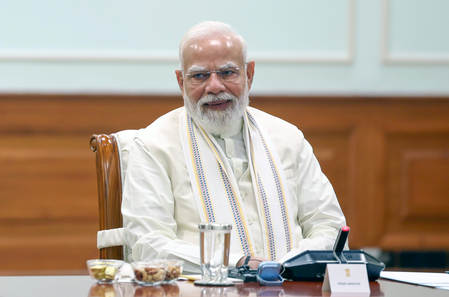
New Delhi: The Union Cabinet on Tuesday credited Prime Minister Narendra Modi’s leadership with ushering in what it described as a “new chapter of peace, development, and trust” in Jammu and Kashmir, citing the abrogation of Article 370, cross-border military operations and measures to strengthen national security among the major decisions taken during his tenure.
In a resolution adopted ahead of PM Modi completing 25 uninterrupted years as head of government on October 7, the Cabinet said unrest in Jammu and Kashmir had remained a major internal and national security challenge for decades, but asserted that the region was now witnessing a new phase of peace, development and public trust.
The resolution listed the abrogation of Article 370 among the decisions that, it said, demonstrated the Prime Minister’s willingness to undertake measures that had remained deferred for decades.
It also cited the 2016 surgical strikes across the Line of Control, the 2019 Balakot airstrikes and Operation Sindoor in May 2025 as examples of what it described as clear national security red lines established under Modi’s leadership.
The resolution said the Prime Minister had clearly defined India’s red lines in matters of national security, adding that the military operations reflected the government’s approach to countering terrorism. It also cited the decision to place the Indus Waters Treaty in abeyance as part of the government’s security approach.
The Cabinet further highlighted the creation of the post of Chief of Defence Staff, the implementation of One Rank One Pension and the replacement of colonial-era laws with the Bharatiya Nyaya Sanhita among the major policy decisions taken during Modi’s tenure.
The resolution also credited the government’s approach with addressing Maoist terrorism and promoting peace in the Northeast through agreements, rehabilitation, development and improved connectivity.
The Cabinet’s resolution marks 25 years since Modi assumed office as Gujarat Chief Minister on October 7, 2001. He subsequently became Prime Minister on May 26, 2014.
Describing the milestone as a significant moment in India’s democratic journey, the Cabinet said Modi had received three mandates in Gujarat and support in three successive Lok Sabha elections, reflecting what it termed the public’s enduring trust in his leadership.
Union Minister Ashwini Vaishnaw, briefing the media after the Cabinet meeting, said the Cabinet had passed the resolution congratulating the Prime Minister and given him a standing ovation.
The resolution described the 25-year period as an uninterrupted journey of public service, saying that while Modi’s responsibilities had expanded from leading Gujarat to governing the country, his stated priorities had remained national interest and citizen welfare.
It credited his governance approach with prioritising the poor, farmers, women, youth and disadvantaged communities, alongside national security, technological development, infrastructure creation and India’s international engagement.
The Cabinet highlighted the expansion of basic amenities and welfare programmes, saying around 60 crore Jan Dhan bank accounts had been opened since 2014 and more than four crore permanent houses had been constructed for the poor under the Pradhan Mantri Awas Yojana.
It said tap-water coverage among rural households had risen from around 17 per cent in 2019 to 82 per cent under the Jal Jeevan Mission. The resolution also cited free ration support for 80 crore needy citizens and healthcare coverage of up to Rs 5 lakh under Ayushman Bharat for more than 60 crore beneficiaries.
According to the resolution, around 25 crore people moved out of poverty between 2013-14 and 2022-23.
On women’s empowerment, the Cabinet cited the role of self-help groups, Mudra loans, home-ownership schemes and livelihood programmes, stating that approximately 3.5 crore women had become Lakhpati Didis. It also referred to the Nari Shakti Vandan Adhiniyam, which provides for one-third reservation for women in the Lok Sabha and State Legislative Assemblies.
For young people, the resolution highlighted the National Education Policy, Startup India, skill development and digital innovation. It said India had more than two lakh recognised startups, generating employment opportunities.
The Cabinet also cited direct income support under PM-KISAN, saying more than Rs 4 lakh crore had been transferred to the bank accounts of over 10 crore farmers. It referred to PM-JANMAN, aimed at particularly vulnerable tribal groups, and measures intended to extend development opportunities to historically disadvantaged communities.
The resolution pointed to an increase in public capital expenditure from Rs 2 lakh crore to more than Rs 12 lakh crore during Modi’s tenure as Prime Minister.
It said the national highway network had expanded from approximately 91,000 kilometres in 2014 to more than 1.46 lakh kilometres, while nearly the entire broad-gauge railway network had been electrified.
Electronics production, which stood at around Rs 2 lakh crore in 2014, had increased to more than Rs 13 lakh crore by 2025-26, the resolution stated. It also highlighted the expansion of defence production and exports, the development of semiconductor manufacturing and the government’s push for self-reliance through the Make in India and Atmanirbhar Bharat initiatives.
The Cabinet cited the Jan Dhan-Aadhaar-Mobile framework and Direct Benefit Transfer as measures that had improved welfare delivery and reduced leakages. It also highlighted the expansion of digital payments through UPI and the implementation of the Goods and Services Tax to create a common national market.
On science and technology, the resolution referred to Chandrayaan-3’s landing near the Moon’s south polar region, the opening of the space sector to private participation and advances in artificial intelligence, quantum technology, biotechnology and clean energy.
It said India’s solar energy capacity had increased from less than three gigawatts in 2014 to more than 160 gigawatts.
The resolution said India’s role on international platforms had expanded under Modi, citing the successful hosting of the G20 Summit in 2023 and the adoption of the Delhi Declaration. It also highlighted India’s advocacy for the Global South and efforts to secure permanent representation for the African Union in the G20.
The Cabinet referred to Vaccine Maitri during the COVID-19 pandemic, when India supplied vaccines and essential medicines to other countries, as an example of the country’s growing capacity to contribute to global challenges.
It further noted that 36 countries had conferred their highest civilian or national honours on Modi and that he had addressed foreign parliaments on 21 occasions.
On climate change, the resolution traced the Prime Minister’s focus on the issue to his tenure as Gujarat Chief Minister, when a separate department for climate change was established in 2009. It cited the subsequent expansion of renewable energy and international initiatives, including the International Solar Alliance, the Coalition for Disaster Resilient Infrastructure and the Global Biofuel Alliance.
The Cabinet also highlighted efforts to promote Indian heritage and cultural identity, including the recognition of the International Day of Yoga by the United Nations, the International Year of Millets in 2023, the redevelopment of Kashi Vishwanath Dham and the consecration of Ram Lalla at the Ram Temple in Ayodhya in January 2024.
The resolution credited Modi’s leadership with guiding the country through major challenges, including the COVID-19 pandemic and the crisis in West Asia.
It said India’s domestic vaccine development and rapid vaccination programme reflected the government’s response to the pandemic. In the case of West Asia, it said timely decisions and measures taken over the preceding 12 years to strengthen energy security had helped the country manage disruptions arising from the conflict.
The Cabinet also highlighted governance initiatives aimed at improving coordination and accountability. It referred to the SWAGAT grievance-redressal initiative launched in Gujarat, which received the United Nations Public Service Award in 2010, and said the programme later inspired the national PRAGATI platform for reviewing stalled projects and resolving implementation hurdles.
The resolution said the replacement of the Planning Commission with NITI Aayog and the establishment of the GST Council had strengthened cooperative federalism by giving states a greater role in policy formulation.
It also noted that the states’ share in central taxes had been increased from 32 per cent to 42 per cent, while the Aspirational Districts and Aspirational Blocks programmes were intended to extend development to underserved areas.
Border villages, previously treated as the country’s last villages, were being repositioned as its first villages, the resolution said, linking infrastructure and development in these areas with national security.
Concluding its assessment of Modi’s 25 years in executive office, the Cabinet said his leadership had focused on public participation, institutional development, economic self-reliance and the expansion of basic services.
It reaffirmed its commitment to the vision of a developed India by 2047, expressing confidence that the country would continue to advance towards becoming prosperous, secure and self-reliant under Modi’s leadership.

