
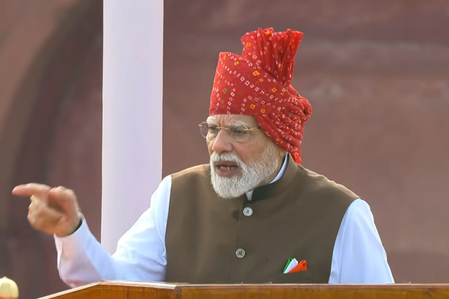
New Delhi: From Gandhinagar to New Delhi, Prime Minister Narendra Modi’s quarter-century in executive office is unusual not only for the uninterrupted time span, but also for his distinctive style of leadership. What makes him stand out as a leader is the combination of centralised decision-making, an emphasis on delivery-driven governance, and an ability to maintain a direct connection with voters across the spectrum, raising his political durability. As documented, the journey began in modest surroundings, where he helped at his family’s tea stall during his childhood while pursuing his education. At 17, he left home and spent nearly two years travelling across India. He later joined the Rashtriya Swayamsevak Sangh (RSS) in Ahmedabad and decided to dedicate his life to the organisation. Over the following years, he rose through RSS ranks, with increasing responsibilities in Gujarat, where the years shaped his organisational abilities, discipline, and grassroots approach to politics. A part of his formative political life lay during the then Prime Minister Indira Gandhi-imposed Emergency, when, according to the Bharatiya Janata Party (BJP) Gujarat account, he worked underground, building resistance and evading government crackdowns. Since 1987, organisational success in the state BJP made him quickly emerge as one of its key strategists, bringing national attention within the party. In 1995, after the BJP’s victory in Gujarat, Narendra Modi was moved to New Delhi as the party’s National Secretary, where he was given responsibility for several northern states. In 1998, he was elevated to the post of National General Secretary (Organisation), among the BJP’s most important positions. In October 2001, the party leadership chose him to replace Keshubhai Patel as Chief Minister of Gujarat. The decision came at a difficult time for the state, which was recovering from the devastating Bhuj earthquake and facing political and administrative challenges. He served as Chief Minister from 2001 to 2014 and Prime Minister since May 2014, where, in a democracy as diverse and competitive as India, sustaining popularity and public support over such a long period is rare. Another defining feature has been his focus on governance as measurable delivery, while PM Modi’s political messaging has consistently emphasised implementation beyond policy announcement. Meanwhile, the country achieved broader economic and social changes where World Bank noted extreme poverty falling from 16.2 per cent in 2011-12 to 2.3 per cent in 2022-23, while it reported substantial progress in infrastructure and access to basic services. Technology may be considered another pillar of the Modi-model. Even critics acknowledge that digital governance has become central to public administration under his leadership. The expansion of Direct Benefit Transfer mechanisms and digital identity systems has transformed India’s payment ecosystem, reducing leakage, increasing transparency, and improving efficiency in public service delivery. Another factor is his ability to blend welfare politics with economic growth narratives. His years in Gujarat were associated with infrastructure expansion, industrial investment, irrigation projects and administrative reforms, creating what supporters called the “Gujarat model”. After moving to New Delhi, he sought to scale aspects of that approach nationally through infrastructure spending, manufacturing initiatives, and reforms such as the Goods and Services Tax (GST) and the Insolvency and Bankruptcy Code (IBC). India’s economic performance strengthened, with the International Monetary Fund projecting the country to remain the world’s fastest-growing major economy, highlighting resilience and strong domestic demand amidst an uncertain global environment. Additionally, it is his communication skills, where through public rallies, social media engagement, radio broadcasts such as “Mann Ki Baat”, and highly personalised political campaigns, he speaks directly to the masses in their language, often bypassing conventional political intermediaries. In foreign policy, under PM Modi’s leadership, India has pursued a more visible international profile, expanded diplomatic engagement, and positioned itself as a key voice of the Global South while simultaneously strengthening ties with major world powers. Analysts frequently cite this more assertive international posture as one of the defining characteristics of the Modi era. While critics have argued, his supporters claim that strong leadership and decisive decision-making were necessary to execute long-pending reforms and large-scale development initiatives. Thus, while marking another milestone, the Prime Minister has undeniably shaped India’s political and governance landscape in ways few leaders have done since Independence. — IANS jb/uk



Precious Kashmir was registered in 2014. Today Precious Kashmir can well and truly take pride in the legacy of its work, and in its contribution towards the building of a free and fair Press in J&K state.
More from CN
Contact
© Precious Kashmir by KWT