
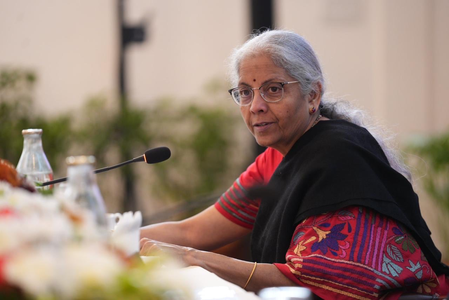
Sitharaman New Delhi: Despite the global uncertainty owing to the West Asia crisis, India has successfully navigated the turbulence while its economic fundamentals remain intact, Finance Minister Nirmala Sitharaman said on Saturday. Addressing the special plenary on “Resilience in an Age of Flux: India’s Economic Priorities” at the 5th Kautilya Economic Conclave (KEC 2026) here, she said that “India has come through this period remarkably well with its fundamentals intact and strengthened”. FM Sitharaman noted that global public debt rose to nearly 94 per cent of GDP in 2025 and is projected to reach 100 per cent by 2029, a level last seen in the aftermath of the Second World War. “A price shock can be cushioned with monetary and fiscal tools. But a quantity shock tests macroeconomic systems, the reach of delivery systems, and therefore the capacity of the state itself. These shocks have arrived in a world with even thinner buffers,” she told the gathering. However, India has come through this period remarkably well, with its fundamentals intact and strengthening. “Real GDP grew 7.8 per cent in the first quarter of FY 2026–27. CPI inflation was about 4.8 per cent in August 2026, and the current account deficit was 0.5 per cent of GDP in the first quarter (Q1 FY27),” said the Finance Minister. She further stated that since 2014, the government has worked to strengthen the capacities on which sustained development depends — the state’s capacity to respond, the economy’s capacity to produce, and the ability of citizens and enterprises to participate in growth. “The first foundation is strengthening resilience at the household level. This has been done by translating public expenditure and government initiatives into tangible improvements in people’s lives. The use of transparent mechanisms, strict monitoring, and a zeal to deliver ensured that government schemes reached the ground,” she mentioned. The Jan Dhan-Aadhaar-Mobile trinity and Direct Benefit Transfer (DBT) strengthened the systems that deliver assistance directly to beneficiaries. Timely implementation of schemes ensured that housing under the PM Awas Yojana, sanitation under Swachh Bharat, clean cooking gas access under Ujjwala, healthcare under Ayushman Bharat, and food security under the PM Garib Kalyan Anna Yojana addressed different sources of household vulnerability. “The second foundation is the capacity to turn economic opportunity into productive activity. Access to finance has been central to this effort. The PM MUDRA Yojana has sanctioned over 52 crore collateral-free loans, supporting self-employment and small enterprises,” she noted. “PM SVANidhi supports street vendors. The formalisation of the economy is also helping increase credit uptake at the desired rate. The government undertook a series of tough banking-sector reforms to strengthen the financial system, including recapitalisation and resolution of stressed assets, along with stronger governance and risk-management frameworks,” according to Finance Minister. Non-food credit grew 18.8 per cent in the year to August 2026, sustaining the flow of finance to economic activity. A strong banking sector is also helping enterprises facing external uncertainties. Working capital and access to markets remain critical. The Emergency Credit Line Guarantee Scheme helped meet working-capital needs, sustain operations and employment, and withstand liquidity pressures during periods of disruption. “The third foundation is the infrastructure that connects people, factories, and markets. Its scale determines how efficiently goods move, how widely businesses can operate, and how fully different regions can participate in the economy. In FY 2026–27 alone, we have budgeted Rs 12.22 lakh crore in capital expenditure, nearly matching, in nominal terms, the Rs 12.39 lakh crore spent by the Centre over the entire decade from 2004–05 to 2013–14, including grants for the creation of capital assets,” Finance Minister emphasised. Effective capital expenditure stands at Rs 17.15 lakh crore, or 4.4 per cent of GDP. “The cumulative results of sustained investments since 2014 are visible: national highways have expanded by about 61%, operational railway routes have more than doubled, and cargo-handling capacity at major ports has increased by 60 per cent,” she said. The fourth foundation is leadership with a strong reform mindset. Prime Minister Narendra Modi approaches reform as a matter of conviction, not compulsion, she said. “The Union government has advanced national frameworks through the GST, the Insolvency and Bankruptcy Code, the four Labour Codes, and the Jan Vishwas Acts,” said Finance Minister. On banking, Sitharaman said the government had undertaken tough reforms, including recapitalisation, resolution of stressed assets, and stronger governance and risk-management frameworks. The banking sector is now helping enterprises navigate external uncertainty, although working capital and access to markets remain critical, she said. Operational airports have more than doubled, and cargo-handling capacity at major ports has risen by nearly 60 per cent. Sitharaman credited the government’s reform record, including the Goods and Services Tax (GST), the Insolvency and Bankruptcy Code (IBC), the Labour Codes and the Jan Vishwas measures. –IANS na/



Precious Kashmir was registered in 2014. Today Precious Kashmir can well and truly take pride in the legacy of its work, and in its contribution towards the building of a free and fair Press in J&K state.
More from CN
Contact
© Precious Kashmir by KWT