
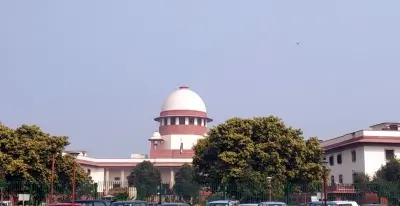
New Delhi: The Supreme Court has ruled that an accused released following a violation of the constitutional safeguards under Article 22 cannot be re-arrested at the discretion of the same investigating authority, holding that any subsequent custody must be preceded by judicial sanction. The judgment was passed by a Bench of Justices Ujjal Bhuyan and Atul S. Chandurkar in an appeal filed by Jaskaran Jeet Singh Deol against the Punjab and Haryana High Court’s order refusing to restrain the investigating agency from seeking his re-arrest in a case registered under the POCSO Act. The top court held that where an accused is released for violation of Article 22(1), which guarantees the right to be informed of the grounds of arrest, the investigating agency must furnish the grounds of arrest in writing and file an application before the concerned Magistrate if it seeks custody. The application must state the reasons and necessity for re-arrest, along with an explanation for the failure to supply the grounds of arrest at the initial stage, the Justice Bhuyan-led Bench said. “To rule out any foul play or collusion, such an application must have the endorsement of the immediate superior authority,” it added. The top court further directed that the concerned judicial magistrate should decide such an application expeditiously, preferably within a week, while adhering to the principles of natural justice. The Supreme Court stressed that the power to re-arrest an accused following a breach of Article 22(1) cannot be left to the discretion of the same authority that violated the constitutional provision. “It must have the judicial imprimatur,” the apex court said, adding that the judicial magistrate may permit re-arrest only after being satisfied that the grounds of arrest could not be furnished initially for bona fide reasons and that the accused needs to be taken into custody. It also directed that when an application seeking custody is presented for endorsement, the superior authority must transfer the investigation to another officer and order a departmental inquiry into the serious lapse. If the inquiry results in an adverse finding against the erring police officers, departmental action must follow, including an entry in their service records, it added. The judgment also examined the consequences of violating Article 22(2), which requires an arrested person to be produced before the nearest Magistrate within 24 hours, excluding the time necessary for the journey. The Justice Bhuyan-led Bench held that the same procedure governing re-arrest after a violation of Article 22(1) must be followed in cases involving a breach of Article 22(2), if the investigating agency continues to seek custody after the accused’s release. It further observed that the High Court may, depending on the facts and circumstances, direct payment of compensation as part of the public law remedy for violation of Article 22(2), while allowing the accused to pursue remedies under private civil law. Relying on its earlier judgment, the Supreme Court reiterated that the grounds of arrest must be furnished in writing, in a language understood by the accused, and that violation of this mandate renders the arrest and subsequent remand illegal. The apex court clarified that it had not expressed any opinion on the merits of the allegations against the appellant and directed circulation of a copy of the judgment to the Director Generals of Police (DGP) of all states and union territories (UTs), Registrars General of High Courts and Directors of State Judicial Academies. –IANS pds/uk



Precious Kashmir was registered in 2014. Today Precious Kashmir can well and truly take pride in the legacy of its work, and in its contribution towards the building of a free and fair Press in J&K state.
More from CN
Contact
© Precious Kashmir by KWT