

Urges unified action against terror ecosystem
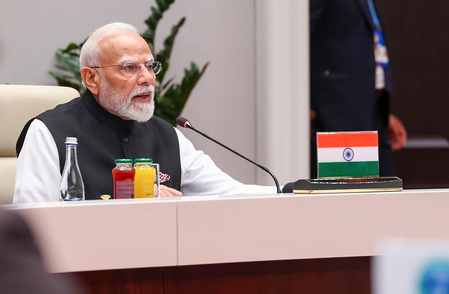
Bishkek, Sept 1: Prime Minister Narendra Modi on Tuesday called on Shanghai Cooperation Organisation (SCO) members to dismantle the entire ecosystem supporting terrorism and said there could be “no place for double standards” on the issue, as he urged the grouping to translate its vision on security, connectivity and opportunity into concrete outcomes.
Addressing the 26th meeting of the Council of Heads of State of the SCO in Bishkek, Modi said terrorism remained a serious challenge to humanity and that the fight against it could not be limited to an “action-reaction” approach.
“We must dismantle the entire ecosystem of terrorist financing, recruitment, radicalisation, and safe havens. We must speak with one voice and make it clear that there can be no place for double standards on this serious issue,” he said.
Modi said countries that use terrorism as an instrument of policy or provide shelter and support to terrorists must receive a clear message that “terrorism cannot be a strategic asset for anyone”.
The Prime Minister also reiterated India’s position that wars and conflicts must be resolved through dialogue and diplomacy rather than on the battlefield. Referring to the crisis in West Asia, he said conflicts in one region increasingly affect the rest of the world through disruptions to energy security, maritime trade and supply chains, with countries of the Global South bearing the greatest impact.
“Therefore, India has consistently called for all tensions and conflicts to be resolved not on the battlefield, but through dialogue and diplomacy,” Modi said.
He also flagged drug trafficking as a serious threat to the younger generation and regional security, and welcomed SCO mechanisms being established to address security threats, organised crime, information security and narcotics. He called for these mechanisms to become effective instruments of practical coordination and timely action.
Modi said peace and stability in Afghanistan remained closely linked to security in the wider Eurasian region and said India would continue its development and humanitarian assistance to the Afghan people.
On connectivity, Modi said strong and reliable links were essential for shared development and prosperity, but stressed that connectivity initiatives must respect the sovereignty and territorial integrity of all countries.
“India supports all efforts that connect markets, facilitate trade, and open new avenues for development. However, respect for the sovereignty and territorial integrity of all countries is essential in these efforts,” he said.
He said future connectivity would need to go beyond roads, railways and air corridors to include simpler customs procedures, digital documentation and more efficient logistics networks.
Marking the SCO’s 25th anniversary, Modi said the grouping should use the occasion to chart a roadmap for the next 25 years and move beyond broad objectives towards tangible results.
“At the previous meeting, I had outlined the three main pillars of India’s vision for the SCO: S — Security, C — Connectivity, and O — Opportunity. The time has come to move these three pillars beyond vision and translate them into concrete outcomes,” he said.
Modi also called for making SCO cooperation more people-driven rather than limited to governments, placing youth engagement and people-to-people ties at the centre of the grouping’s next phase.
He highlighted India’s initiatives within the SCO, including the SCO Start-up Forum, Young Authors’ Conclave and Young Scientists’ Forum, and said the first session of the SCO Civilizational Dialogue Forum, proposed by India last year, would be held in India this year.
“For India, the SCO is a confluence of great civilisations, cultures, and ideas,” Modi said, adding that technology, entrepreneurship, innovation and start-ups offered significant opportunities for people across SCO countries.
The SCO comprises 10 member states — Belarus, India, Iran, Kazakhstan, China, Kyrgyzstan, Pakistan, Russia, Tajikistan and Uzbekistan.

