

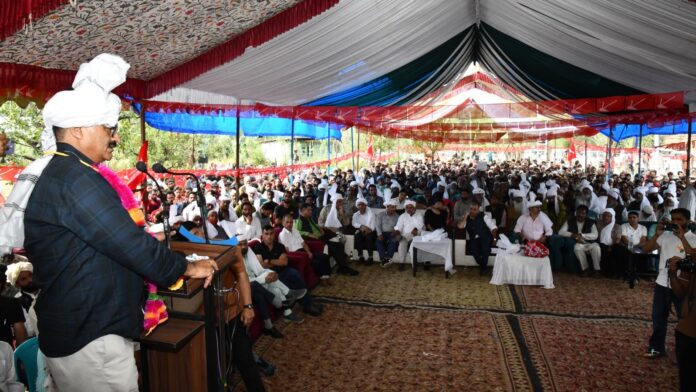
Attends Tribal Convention on FRA at Pulwama
Hints at dev of Sangerwani as model tribal tourism village
PULWAMA, AUGUST 25: Maintaining that the Forest Rights Act (FRA), 2006 serves as a catalyst for tribal welfare and livelihood enhancement, Minister for Jal Shakti, Forest, Ecology & Environment and Tribal Affairs, Javed Ahmed Rana, Tuesday said that effective implementation of the Act is essential for empowering the forest-dwelling tribal communities, safeguarding their legitimate rights and creating sustainable livelihood opportunities.
He said this while participating in a Tribal Convention on the Forest Rights Act, 2006, at Sangerwani, Rajpora, Pulwama where he also interacted with the locals to assess their grievances.
MLA Rajpora, Ghulam Mohi ud din Mir, MLA Pampore, Hasnain Masoodi, fomer legislator Mohd Khalil Bandh and officers from the district administration were present on the occasion.
The convention focused on creating greater awareness about the provisions of the Forest Rights Act and strengthening community participation in its effective implementation. Detailed discussions were held on the rights and entitlements being provided under the legislation, the process for filing and verification of claims and the role of Gram Sabhas and other stakeholders in ensuring that eligible forest-dwelling tribal communities receive the rights guaranteed to them under the Act.
The convention was attended by a large number of people from various areas who raised various sector specific and development demands. They sought intervention of the Minister in early redress of the same.
The people highlighted issues concerning augmentation and upgradation of water filtration plants to ensure the availability of safe and reliable drinking water. They sought strengthening of healthcare and educational infrastructure, including improvement of existing facilities and provision of better services for the local population. The people also highlighted the need for improvement and upgradation of road infrastructure, particularly the repair of damaged stretches and better connectivity to facilitate smooth movement of people and goods.
Addressing the gathering, the Minister assured that the government remains committed to strengthen the basic infrastructure and improve the public services, with particular focus on reliable drinking water supply, better healthcare and educational facilities and improved road connectivity. He stressed that the issues raised during such public interactions provide valuable inputs for prioritising development works and ensuring that the benefits of government initiatives reach the people effectively.
Responding to the concerns regarding drinking water, the Minister directed the concerned authorities to undertake the improvement and revamping of 14 filtration plants in Rajpora Constituency. He announced ₹2.75 crore for the revamping and improvement of water filtration plants, aimed at strengthening water supply infrastructure and ensuring better access to safe and quality drinking water for the local population.
He also directed the Soil Conservation Department to prepare a Detailed Project Report (DPR) worth around ₹1 crore for taking up soil conservation and related development works in the Sangerwani area.
The Minister stated that Sangerwani would be developed as a Forest Village under the Forest Rights Act (FRA), 2006, in accordance with the provisions of the Act. He announced that efforts would be made to bring Sangerwani on the tourism map and develop it as a model tribal tourism village, showcasing its natural beauty, tribal heritage, culture and traditional way of life.
Regarding the Forest Rights Act, Javed Rana emphasised that it is an important legislation aimed at recognising and securing the legitimate rights of Forest Dwelling Scheduled Tribes (FDSTs) and Other Traditional Forest Dwellers (OTFDs). He stressed the need for sustained awareness and community outreach so that no eligible beneficiary is deprived of the rights provided under the law.
Rana highlighted that the Act provides a framework for recognising individual and community forest rights while also enabling the tribal communities to protect their cultural heritage, traditional livelihoods and customary relationship with forest resources. He called for a balanced approach that promotes both community empowerment and sustainable forest conservation.
“Awareness is the first step towards empowerment. We must ensure that every eligible tribal family is aware of its rights and has the necessary support to exercise those rights. Effective implementation of the Forest Rights Act must translate into greater dignity, livelihood security and meaningful participation of tribal communities in their own development,” Rana said.
The Minister called for regular awareness programmes and community-level consultations to address concerns, clarify provisions of the Act and strengthen people’s participation in the implementation process. He maintained that recognition of forest rights should be complemented by convergence with various government schemes aimed at improving livelihoods, infrastructure, skill development and access to basic services for tribal communities.
The participants shared their experiences and raised various issues concerning recognition of forest rights, livelihood opportunities, access to government schemes and other development concerns.
The Minister assured that the genuine concerns raised during the convention would be examined and addressed through appropriate mechanisms.

