

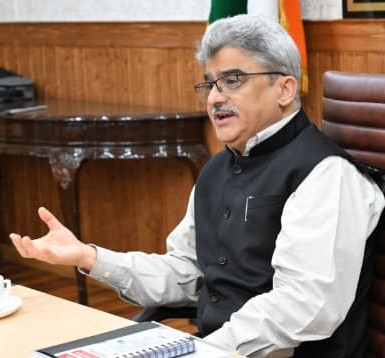
Reviews progress on CITaG’s governance, development initiatives
SRINAGAR: Chief Secretary, Atal Dulloo Wednesday chaired a high-level review meeting to assess the progress, strategic interventions and future roadmap of the Centre for Innovation and Transformation in Governance (CITaG), J&K, with particular focus on policy formulation, knowledge outputs, public-private partnership (PPP) projects and initiatives aimed at accelerating socio-economic development across the Union Territory.
During the meeting, the Chief Secretary emphasized the need for establishing a dedicated Special Purpose Vehicle (SPV) to comprehensively oversee PPP projects, including their conceptualisation, development, progress, execution and outcomes on the ground.
He further directed that a dedicated digital portal for PPP projects in the pipeline be developed to facilitate real-time monitoring and enable senior officers to maintain close oversight over their progress. He observed that such a mechanism would ensure effective follow-up, identify bottlenecks at an early stage and facilitate timely execution of projects.
The Chief Secretary called upon departments, particularly the Housing & Urban Development Department (H&UDD), Tourism, Science & Technology and Power, to undertake regular review and follow-up of their projects and policy initiatives so that these are translated into tangible outcomes and grounded expeditiously.
Highlighting the potential of Jammu and Kashmir’s abundant water resources, he underscored the importance of small hydropower projects and called for making optimum use of this potential as part of the UT’s broader energy development strategy.
The Chief Secretary also advised CITaG to explore an innovative education framework focused on identifying and addressing individual learning gaps among students. He suggested that well-researched and evidence-based interventions may be developed to strengthen students’ motivation, confidence and capabilities, particularly in areas where they face learning or communication challenges, drawing upon successful practices followed in developed States and countries across the world.
Giving a detailed presentation, CEO, CITaG, Dr Sandeep apprised the meeting of the progress achieved under its institutional partnership with different government Departments of J&K.
It was highlighted that against the original Memorandum of Understanding (MoU) target of 28 deliverables by August 2026, CITaG has tracked 100 knowledge-output projects, reflecting a significant expansion in the scope of policy research, strategic advisory and institutional support being provided to the UT administration. The milestone MoU between the Planning, Development & Monitoring Department and IIM Jammu has also been extended for a further two years, providing a longer-term institutional framework for continued policy innovation and governance transformation.
The current knowledge-output portfolio includes 21 completed deliverables, covering major interventions such as the J&K Road Safety Plan 2026, J&K Electric Vehicle Policy 2026, J&K Circular Economy Policy 2026, Compressed Bio-Gas Policy, Urban and Rural Mobility Plans and the PPP Project Lifecycle Tracker, which have been submitted and adopted by the concerned departments.
Moreover, another 20 strategic frameworks have been submitted and are under review, covering areas such as attracting FDI, J&K GCC Policy 2026, Agri-Startup Policy, Tourist Safety Policy Framework and sector-specific viability analyses. Seven further deliverables, including the J&K Youth Policy 2026, HR Management & Manpower Auditing, Capital Adequacy and Leveraging of Assets for J&K Bank and blueprints for Model Industrial Estates, are scheduled for submission during August 2026.
It was also revealed that sixteen initiatives are presently under active development, including the roadmap for doubling the GSDP economy, Ease of Doing Business benchmarking and Business Process Re-engineering of the J&K Single Window System. Another 36 future deliverables have been structured for implementation through 2027, focusing on emerging areas such as blockchain and artificial intelligence in governance, digitisation of data and models for Panchayat-level self-sustainability.
The Chief Secretary directed all concerned departments and agencies to maintain close coordination with CITaG and ensure that policy recommendations and project proposals move swiftly from the stage of conceptualisation to implementation, with measurable outcomes and clear accountability at every stage.

