

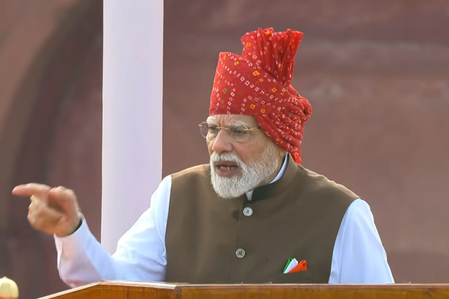
Announces free online coaching for competitive exams
25 cr people overcome poverty in last 12 years
1 cr youth to be trained in AI skills within a year
New Delhi: Prime Minister Narendra Modi on Saturday unveiled a seven-pillar roadmap for achieving a Viksit Bharat by 2047 and outlined a series of policy initiatives spanning technology, manufacturing, defence, energy, education, sports and social welfare during his address to the nation from the ramparts of the Red Fort on the occasion of the 80th Independence Day.
Extending greetings to citizens, Modi said India was celebrating not only 80 years of Independence but also 150 years of Vande Mataram, and paid tributes to freedom fighters and revolutionaries.
He also expressed solidarity with people affected by recent floods and landslides, assuring them of the country’s support.
The Prime Minister said nations become great when they move forward on the strength of their aspirations and capabilities, asserting that India had set a firm goal of becoming a developed nation by the centenary of Independence in 2047.
He said the achievements of the past decade had strengthened confidence that the goal was attainable.
Highlighting progress made during the past 12 years, Modi said 25 crore people had overcome poverty and India had transformed from being counted among the “Fragile Five” economies to becoming the world’s fastest-growing major economy.
He cited a four-fold increase in defence production, five-fold growth in Khadi and village industries, seven-fold expansion in electronics manufacturing, a 21-fold rise in railway coach production and a 33-fold increase in mobile phone manufacturing.
He also pointed to rapid growth in internet users, patent grants and digital transactions, alongside accelerated delivery of tap water connections, LPG connections, toilets and housing.
Modi stressed the need for greater self-reliance, saying India must reduce dependence on foreign imports and build domestic capabilities in strategic sectors.
Referring to semiconductors as critical to the future economy, he said three semiconductor plants were already operational and exporting chips globally, while seven to eight additional production facilities were expected to become operational within the next one to two years.
The Prime Minister also highlighted the National Critical Minerals Mission and the proposed Critical Minerals Corridor, saying India had emerged as a trusted global partner in securing critical mineral supply chains.
In the energy sector, Modi announced a target of achieving 100 GW nuclear power capacity by 2047 and said five new reactors would become operational within the next six to seven years.
He said India had also taken significant steps towards self-reliance in nuclear fuel and was expanding domestic oil and gas exploration through offshore projects backed by the Rs 85,000-crore Samudra Manthan initiative.
Highlighting progress in clean energy, he said City Gas Distribution had expanded from 70 cities to 700 cities, piped cooking gas now reached 1.75 crore households and solar power capacity had increased from 2 GW to 160 GW.
He also said the PM Surya Ghar Muft Bijli Yojana had crossed 50 lakh beneficiary households, providing assistance of up to Rs 80,000 per family and enabling many households to generate income through sale of surplus electricity.
Modi said India had completed 100 per cent railway electrification within a decade and announced that work had begun on the country’s first indigenous hydrogen train, which he described as the world’s longest and most powerful hydrogen train.
Referring to global disruptions caused by the Covid-19 pandemic and conflicts in Ukraine and West Asia, Modi said India’s planning and preparedness had ensured stability despite international challenges.
He also defended the government’s support to farmers through fertiliser subsidies, saying urea and DAP were being supplied at heavily subsidised rates despite soaring global prices.
The Prime Minister said India’s growing global stature and political stability had enabled the country to sign Free Trade Agreements with around 40 countries since 2014, opening opportunities for exports from agriculture, fisheries, textiles and MSMEs.
He urged Indian industries to focus on producing globally competitive products that were both high-quality and affordable.
Calling for a transformation in work culture and governance, Modi said India must accomplish in the next five to seven years what had remained unfinished for decades.
He also announced a new strategic framework, Saptdhara or Sapt Shakti, to guide India’s development journey.
Under the first pillar, Manufacturing Power, Modi called for strengthening complete domestic value chains and making India a reliable global supply-chain hub.
The second pillar, Agriculture and Food Processing, focuses on chemical-free farming and integrated farm-to-export networks.
The third pillar, Technology and Innovation, aims to position India as a global centre for AI, quantum computing, robotics, space technology, Digital Public Infrastructure and Made-in-India 6G.
The fourth pillar, Gati Shakti, envisages modern logistics through railways, highways, waterways and ports. The fifth pillar, Defence Shakti, seeks to make India a leading global supplier of advanced defence technologies, including drones, counter-drone systems and hypersonic technologies, while also strengthening cyber security.
The sixth pillar focuses on the Green and Blue Economy through green hydrogen, renewable energy, energy storage and marine development. The seventh pillar centres on India’s Soft Power, including yoga, Ayurveda, tourism, VFX, animation, gaming and the creative economy.
In a major announcement, Modi said one crore young Indians would be trained in Artificial Intelligence skills within the next year. He said the government would ensure that Indian youth possessed the capabilities needed to lead globally in the rapidly evolving AI sector.
The Prime Minister highlighted the growth of India’s startup ecosystem to 2.5 lakh registered startups and pointed to initiatives such as the Rs 1 lakh crore Research and Innovation Fund, Skill India, Khelo India, the National Drone Policy, private sector participation in space and the National Education Policy 2020 as measures supporting youth empowerment.
He said the number of universities had risen from fewer than 350 to nearly 1,000, while medical colleges had increased from less than 400 to around 850. He also highlighted the role of over 10,000 Atal Tinkering Labs and praised youth-led startups for successfully launching private satellites and rockets.
Modi announced a nationwide free online coaching programme for competitive examinations, saying Digital Public Infrastructure and leading educators would be brought together to provide quality educational support to students without financial burden.
The Prime Minister highlighted India’s improving sporting performance and reiterated the country’s ambition to host the 2030 Commonwealth Games and the 2036 Olympics. He also announced a nationwide Sports Talent Hunt for children aged between five and 15 years to identify and train future champions from villages and schools across the country.
Calling substance abuse a serious threat to the country’s future, Modi launched a 100-week anti-drug campaign under the Nasha Mukt Yuva Abhiyan and appealed to families, NGOs and spiritual organisations to participate in the movement for a drug-free India.
On internal security, Modi said Naxalism had been effectively dismantled after decades of violence and warned against ideological extremism. He called for identifying and isolating such elements while connecting youth with the mainstream.
The Prime Minister also announced the creation of a modern voluntary Civil Defence network to strengthen preparedness against emerging threats, noting that contemporary warfare increasingly targets critical infrastructure. He added that India’s defence exports had expanded more than 50 times and were now reaching around 100 countries.
Highlighting the role of women in nation-building, Modi said the government had surpassed its target of creating three crore Lakhpati Didis and announced a new target of six crore. He praised women working in sectors ranging from aviation and defence to semiconductor manufacturing and called on political parties to expedite implementation of one-third reservation for women in Parliament and state legislatures.
The Prime Minister also said social security coverage had expanded from around 25 crore people before 2014 to nearly 100 crore beneficiaries today. He highlighted the Ayushman Bharat scheme, saying it had provided free healthcare coverage of up to Rs 5 lakh to senior citizens above 70 years and helped families save an estimated Rs 2 lakh crore in medical expenses.
Referring to India’s first Digital Census, Modi urged citizens, particularly the youth, to assist families in completing digital self-registration to ensure accurate data for policymaking and development planning.
Concluding his address, the Prime Minister reiterated the Panch Pran and called upon citizens to place national interest above self-interest, abandon colonial mindsets and work collectively to transform India into a developed nation by 2047.

