

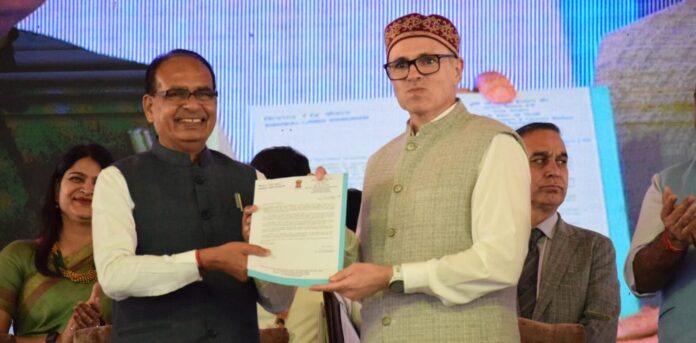
Rs 3,566 cr road projects cleared; approval handed to CM
Srinagar: Rural infrastructure, women’s empowerment and agriculture-led development in Jammu & Kashmir received a major push Tuesday as Union Minister for Agriculture & Farmers’ Welfare and Rural Development Shivraj Singh Chouhan handed over the sanction letter for road projects under the Pradhan Mantri Gram Sadak Yojana (PMGSY-IV, Batch-II) to Chief Minister Omar Abdullah at a function held at Sher-i-Kashmir International Conference Centre.
The approved road projects, worth Rs 3,566 crore, form part of nearly Rs 8,000 crore sanctioned for Jammu & Kashmir within a year, which the Union Minister described as a “historic achievement.”
On the occasion, a Mother Sanction of over Rs 4,568.23 crore was also released under the Deendayal Antyodaya Yojana National Rural Livelihoods Mission for 24 States and Union Territories.
The programme was attended by Deputy Chief Minister Surinder Kumar Choudhary, Minister for Agriculture, Rural Development, Panchayati Raj, Cooperation and Elections Javed Ahmad Dar, Leader of Opposition Sunil Kumar Sharma, Members of Parliament, MLAs, Secretary Ministry of Rural Development Rohit Kansal, senior officials, and a large number of farmers, rural residents and women beneficiaries.
Addressing the gathering, Chouhan said he had come to Jammu & Kashmir “with a spirit of service” and not merely in an official capacity. Under the leadership of Prime Minister Narendra Modi, he said, the Centre is committed to “connecting hearts along with roads,” adding that both “the doors of the heart and Delhi are open” for the people of the Union Territory.
He said Jammu & Kashmir was prioritised in both phases of PMGSY-IV approvals, reflecting the Centre’s focus on the region. Emphasising the broader impact of connectivity, Chouhan noted that roads would link villages to schools, hospitals, markets and employment opportunities, ensuring inclusive development.
Highlighting women’s empowerment, the Union Minister said the Rs 4,568 crore Mother Sanction under DAY-NRLM would strengthen Self-Help Groups across the country. Addressing women in Jammu & Kashmir, he said the aim is not just to create “Lakhpati Didis” but to build strong entrepreneurs. He, along with the Chief Minister, also felicitated several Lakhpati Didis during the event.
On agriculture, Chouhan acknowledged challenges such as small landholdings, difficult terrain and weather risks in Jammu & Kashmir. He said the Centre would support the region through the Holistic Agriculture Development Programme, including promotion of improved planting material, high-quality nurseries and scientific crop diversification. He also announced that a team of scientists from the Indian Council of Agricultural Research would be deputed to study the region’s climate, soil and water resources and prepare a comprehensive roadmap.
Advocating integrated farming, he said farmers could enhance incomes by combining agriculture with allied activities such as animal husbandry, fisheries, sheep and goat rearing, and beekeeping. The Centre, he added, would work closely with the Jammu & Kashmir Government to design sustainable and employment-oriented agricultural programmes.
In his address, Chief Minister Omar Abdullah welcomed the Union Minister, describing him as a “true friend and well-wisher” of Jammu & Kashmir. He expressed gratitude for the continued support extended to the region and termed the Rs 8,000 crore approval as “extraordinary,” assuring that the government would ensure its speedy implementation.
The Chief Minister said improved road connectivity is crucial for Jammu & Kashmir given its hilly terrain and scattered population. He noted that earlier phases of PMGSY had already transformed rural access to essential services, and Phase-IV would help connect the remaining habitations.
Abdullah assured that the government would utilise central assistance effectively and implement the projects with full seriousness to bring tangible improvements in the lives of rural communities, farmers, horticulturists and women associated with Self-Help Groups.

