

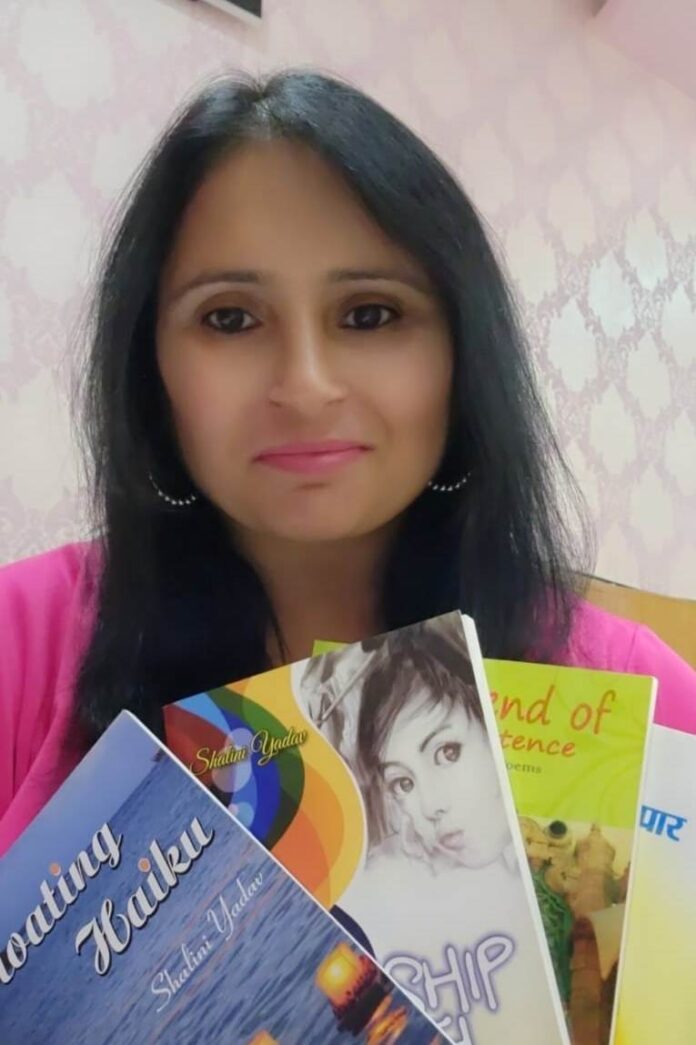
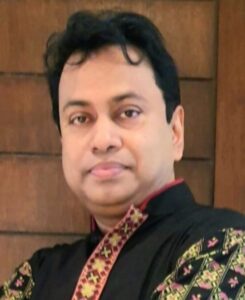
A prodigious scholar, writer, columnist and professor, Dr. Shalini Yadav, with a doctorate and a career entrenched in academia, research, and literary circles, has carved a niche in literary arena. Dr. Yadav has penned and edited fourteen captivating books that traverse diverse subjects and earned accolades including Savitribai Phule Excellence Award and Dr. A.P.J. Abdul Kalam Award. Dr. Yadav ardently participates in various capacities within the academic and literary realm; her esteemed place on the editorial boards of international journals and magazines speaks volumes. Not only she crafts articles, poems, and short stories, but also graces the pages of esteemed newspapers, she graces conferences as a speaker and chair. With numerous publications in National and International journals, she as a research supervisor steers scholars on their path to enlightenment. I, Toufiq Zohur, poet from Bangladesh share some parts of my conversation with her here:
1. When did you first start to write?
I first started to write in 2012, during my time in the Kingdom of Saudi Arabia. Surrounded by the symphony of Arabic language speakers, I felt a profound sense of solitude. It was in that desert of loneliness that I found solace in the art of poetry. Every word I penned felt like a drizzle or a fresh raindrop, nourishing my soul and satisfying the depths of my being. And so, I wrote, almost every day, using the language of poetry to express the unspeakable.
2. Who is the most influential in your life as far as writing is concerned?
As for the most influential person in my writing journey, poetry has a way of weaving its magic through every poetic piece beautifully crafted by a poet. However, the works of John Donne, Kamala Das, and Amrita Pritam have resonated deeply within me, igniting a fiery passion for poetry and inspiring my own writing. Walt Whitman, Rudyard Kipling, John Keats, P B Shelley, and if I talk about Indian poets Kamala Das, Sarojini Naidu, Rabindranath Tagore have been influential in my life. Rabindranath’ Gitanjali inspires for equality, humanity, peace, universality etc. In contemporary poets, I like feminist poetry of Meena Kandasamy and Rochelle Potkar.
3. What is the definition of poetry in your thoughts?
To define poetry is to capture something ethereal, a delicate thread that weaves through the fabric of our existence, a feather couch or clouds’ chesterfield where one can sit or laze and delve into the depths of their emotions, whether real or surreal. It is a means to relish the beauty of life and nature, stirring the senses and transporting the reader to a realm where words paint a vivid tapestry of experiences.
4. What power is there within poets pen?
The power within a poet’s pen is immeasurable. It possesses the ability to heal, to awaken the love within us for every being on this earth, to provide us with a sense of purpose and rejuvenation, and to grant us strength in times of despair and uncertainty. It is like dopamine for adrenaline rush. It unites people and teaches the universal human values inside them including love, trust, empathy etc.
In the context of mystic land of India, if I speak, the ethereal art of ‘Kavya’ holds a celestial sway, for our drapery of history is woven with intricacies of epics and the lyrical verses of august poets like Valmiki, whose mahakavya echoes with profound significance. In the sacred verses penned by such literary luminary denizens, whispers of mythological sagas and celestial beings intertwine, painting vivid portraits of cosmic battles and divine quests. It is within these poetic crescendos that the fabric of our past is eternally preserved, illuminating the path for generations to come.
Beyond the territory of transcendence, poetry bears witness to the tumultuous era of colonial rule that once shrouded our nation in chains of oppression. In the shadows of darkness, poets emerged as fiery warriors, kindling flames of awakening through their eloquent verses. Their words, resplendent with fervent emotions and unwavering resolve, served as celestial weaponry, empowering the hearts and minds of their brethren to rise against the shackles of subjugation. Therefore, the symphony of poetic rebellion heralded an era of liberation, setting ablaze a longing for freedom that burned brighter than the sun, etching the legacy of our dedicated poets in the annals of time.
I would like to quote here, P. B. Shelley’s essay “Defence of Poetry” which is unique compared to other writings defending poetry. Instead of providing rules or judgments, Shelley’s essay serves as a primer. Shelley refutes his friend Thomas Love Peacock’s argument that poetry is worthless in the age of science and technology. He argues that reason and imagination are essential aspects of human perception, and poetry plays a vital role in advancing civilization. Shelley sees poets as prophets who participate in the eternal and divine, creating poems that reflect the unchangeable forms of human nature. He also highlights the utilitarian value of poetry in awakening and expanding the mind. Shelley concludes by praising the significant role of poets and proclaiming them as the unacknowledged legislators of the world.
Padma Shree awardee, Sambalpuri poet, Haldhar Nag who has written poems covering societal issues, casteism, religious concerns, nature, marginalization etc. is an inspiration and ipso facto proves the importance of poetry in communities and for social change. Hence, we can always rely on the proverb- ‘the pen is mightier than the sword’.
5. Is there something regarding writing that you would like to achieve that you have not achieved?
As a poet, my aspirations go beyond mere achievements. Poetry, by its very nature, is a progressive art form, always evolving and pushing the boundaries of expression. My goal is to continue growing as a poet, to delve deeper into the recesses of my soul, and to let my words dance on the page, touching the hearts of readers and resonating with their own experiences.
6. ‘Poetry has no boundaries’- do you believe poetry can change the world by its own dream way?
While poetry is my true calling, I am not confined solely to its embrace. As the saying goes, “Poetry has no boundaries.” I believe that poetry has the power to change the world, just as Rabindranath Tagore’s poetry and songs united Bengal. There have been countless poets throughout history whose words have transcended borders and spoken to the universal human experience. To illustrate more, ‘The Passion of Poetry’ a poetic community founded by Annette Tarpley from USA and Uddan TV, founded by you, Toufiq, are doing the same, eradicating various kinds of boundaries including race, gender, religion and ethnicity among poets across the seas.
7. Poetry readers are always few in numbers. Modern poetry is also very complicated. So Readers don’t feel interested to read Modern Poetry. What do you think?
It is true that poetry readers are often few in number, and modern poetry can be intricate and complex, but poetry by Shakespeare and Milton was not porridge to gulp easily. However, poetry is sustenance for the brainy souls, the ones who seek solace in the written word. It is not a genre for just anyone, as it requires a certain level of engagement and willingness to explore deeper meanings. The modern world, with its focus on instant gratification and superficiality, sometimes fails to captivate readers with the complexities of modern poetry. Additionally, poets who use sophisticated vocabulary or cater to urban dwellers may struggle to connect with a wider audience. The joy of reading and relishing poetry lies in its flow, and if a reader needs to constantly refer to a dictionary for comprehension, the essence and beauty of the poem may be lost. This issue is not exclusive to modern poetry, as throughout history, there have always been poets whose writing also necessitated interpretation and guidance.
8. How many poetry books have you published? Besides poetry, do you write anything?
In terms of my literary accomplishments, I have published four poetry books thus far, each offering a unique glimpse into the depths of my soul. From “Till the End of Her Subsistence,” to “Kinship With You,” “Floating Haiku,” and even a collection in Hindi titled “Kshitiz Ke Us Paar,” my words have found their way onto the printed page. Beyond poetry, I have also delved into the realm of editing, curating an anthology “Across the Seas” that brings together the works of 43 exceptional poets from more than 27 countries. Additionally, I explore other forms of writing such as short stories, haibun, articles, and research papers, always seeking new avenues for creative expression. I do write columns for English Indian newspapers.
9. What is your future plan about your poetry?
Looking towards the future, my poetry holds within it a vision of unity and growth. Last year, we embarked on a literary venture, creating a literary e-magazine called “Glitterati” to support and promote poets and writers from all corners of the globe. Through poetic shows, open mic events, and talks and gatherings, we aim to foster a community where ideas are shared, poetry is celebrated, and creativity blossoms. As a poet, I believe in the power of collective growth, and I find great joy in promoting the voices of others while continuing to nurture my own craft.
10. What is your advise for novice writers?
For novice writers, I offer this advice: listen to the whispers of your soul, don’t ever ignore it and let the words pour forth through the vessel of lexis. Begin by expressing yourself without diffidence, but as you progress, consider the nuances of linguistic competence, keep a check on syntax and semantics. Immerse yourself in the vast ocean of knowledge, conducting research to enrich your writing and make it better with each passing day. Let the spirit of curiosity guide you, and remember that every word you write is a step towards your own artistic evolution.

