
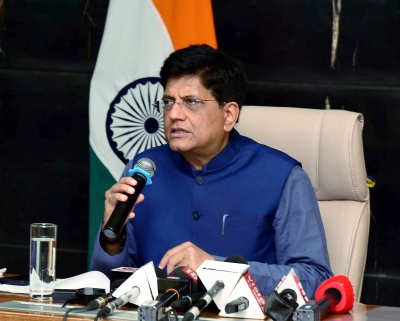
New Delhi: Commerce and Industry Minister Piyush Goyal on Monday called upon businesses in India and the United Kingdom to translate the opportunities created by the India-UK Comprehensive Economic and Trade Agreement (CETA) into expanded trade, investment, partnerships, and job creation. Addressing the 16th Session of the India-UK Joint Economic and Trade Committee (JETCO), he said the two countries should aim to double bilateral trade by 2030 and make the India-UK Vision 2035 a framework for greater economic ambition and cooperation. Goyal said the comprehensive economic and trade agreement (CETA) between the two countries marks a major milestone, providing zero-duty access in the United Kingdom market for most Indian exports while opening up significant opportunities for UK exporters across sectors. The agreement has also opened up new opportunities in services. He added that the Social Security Double Contribution Convention could further benefit both economies through the supply of services at competitive prices and improved profitability. India and the UK were complementary economies with considerable potential to expand existing trade, develop new export opportunities and diversify the range of products exchanged, he said. Highlighting the existing trade complementarities, the minister noted that India was a major exporter of smartphones, pharmaceutical products, jewellery, textiles, leather goods, rice and certain agricultural products, iron and non-alloy steel, machinery parts, and auto components. On the UK side, he identified potential in the supply of products across the petroleum value chain, technology products in electronics and electrical equipment, medicaments, motor cars and Scotch whisky. Setting out five priority areas for India-UK cooperation, Goyal said infrastructure and clean energy offered opportunities in project development, renewable energy, transmission lines, and utility financing to support sustainable growth in both countries. The second area was advanced manufacturing and resilient supply chains, particularly in electric vehicles, batteries, electronics, and precision engineering. He said cooperation should help build competitive manufacturing ecosystems, strengthen supply-chain resilience and enhance confidence between the two trusted partners. The third priority was technology and innovation. He called for stronger links between educational and research institutions, technology companies and start-ups, alongside greater research and development cooperation. He highlighted opportunities for collaboration in semiconductors, quantum computing and artificial intelligence. The fourth area was financial services, where he called for greater collaboration between the City of London and GIFT City in Gujarat’s Gandhinagar. He identified fintech, insurance, cross-border payments, transition finance and trade finance as areas for cooperation, adding that the two financial centres should work towards becoming a connected pathway to greater progress and prosperity. The fifth area was healthcare and consumer sectors. Goyal highlighted opportunities in generic pharmaceuticals on the Indian side and branded and innovative pharmaceutical products on the UK side, as well as diagnostics, food processing and consumer goods. Addressing the session, the UK’s Secretary of State for Business, Innovation, Science and Trade, Jonathan Reynolds, said that the conclusion of CETA marked the beginning of a sustained and practical dialogue between governments and businesses on both sides. With CETA having been in force for almost 100 days, he said there were encouraging signs of businesses in both countries beginning to use the agreement and explore new opportunities across advanced manufacturing, clean energy, life sciences, technology, services and creative industries. He emphasised that the agreement’s success would depend on businesses using it to expand exports, investment and partnerships. –IANS sps/vd



Precious Kashmir was registered in 2014. Today Precious Kashmir can well and truly take pride in the legacy of its work, and in its contribution towards the building of a free and fair Press in J&K state.
More from CN
Contact
© Precious Kashmir by KWT