

Targets top-3 economy, manufacturing hub
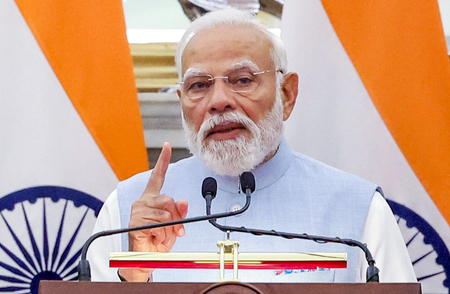
New Delhi: Prime Minister Narendra Modi on Wednesday set “We will do it” as a new rallying cry for achieving the goals of a Viksit Bharat by 2047, asserting that India has moved from “policy paralysis” to “reform express” since 2014.
Addressing the Viksit Bharat Sankalp Sabha in New Delhi as he marked 25 years in public office, Modi said the country had transformed from an era of economic pessimism to one of greater resilience and confidence.
“Today is not just a day for memories; it is a day to fill our resolutions with new energy. It is a day to reiterate that promise, to express that determination which says, ‘We will do it! We will do it! We will do it!’” he said.
The gathering repeatedly echoed the slogan after the Prime Minister.
Listing his government’s goals, Modi called on the people to repeat “We will do it” for each aspiration, including making India a developed country by 2047, becoming one of the world’s top three economies, achieving an Atmanirbhar Bharat, becoming a global manufacturing hub, hosting the Olympics and taking India further into space.
Looking back at the situation when he became Prime Minister in 2014, Modi said the country was “immersed in despair and disappointment” and facing formidable challenges.
“Regarding India’s economy, the world had started saying, ‘It’s a gone case’. There was no growth to be seen anywhere, inflation was touching the sky, and a country immersed in despair and disappointment once again needed a new sense of confidence,” he said.
Modi said the situation had changed over the past 12 years, contrasting what he described as the previous era of “policy paralysis” with the present “reform express”.
“Back then, there was talk of policy paralysis, and today there is talk of the reforms express. Earlier, ways were being found to increase imports, and today new export records are being set,” he said.
He also cited mobile phones and power generation as examples of the change, saying India had earlier imported the mobile phones it needed but was now producing phones domestically, while power shortages that once made headlines had given way to greater attention to India’s solar power capacity.
Modi identified agriculture as another example of what he described as the country’s transformation, claiming that the 2015-2025 decade had recorded the highest agricultural growth in any decade since Independence.
“The decade from 2015 to 2025 has broken all records for agricultural growth,” he said.
He attributed the change to what he called clear intent and policies, and said his government had pursued “saturation” in welfare delivery, under which every eligible beneficiary is covered and no rightful beneficiary is left out.
“This is saturation, and this is the real story of change,” he said.
Modi also linked his approach to governance with the principle of “Sabka Saath, Sabka Vikas”, arguing that public services and development benefits should not be divided along caste or community lines.
“If the problem affects everyone, the solution should also be for everyone,” he said.
Reflecting on his 25 years in public service, Modi said the focus should not be merely on his own journey but on the progress made by the country.
Recalling his tenure as Gujarat Chief Minister, he said he had always regarded the development of the state as part of the country’s overall development. He said his lack of administrative experience at the time was offset by his faith in people and the experience he had gained through years of social work.
“I took decisions by taking the people along, formulated policies with the people and implemented them with the people,” he said.
Modi said the collective strength of India’s 140 crore people would be central to achieving the country’s future goals.
“There is no reason for India to stop now. And friends, I am talking about 100 years ago, when we were less than 40 crore people. Today, we are more than 140 crore. Together, the 140 crore citizens of India will build a Viksit Bharat by 2047, and we certainly will! We will do it!” he said.
Referring to Indian pilot Captain Smit Machchhar, whom he described as being praised globally for his bravery, Modi said India’s aviation capabilities would also expand.
“Today, India’s pilot is being discussed across the world. One day will also come when, just as India’s pilots are being discussed today, the world will talk about Made in India planes,” he said.
The Prime Minister said achieving the country’s goals would require visionary policies and sustained effort.
“Our country has problems, but we also have 140 crore solutions. Now is not the time to rest. This is the time to move forward with enthusiasm and dedicate ourselves to the country,” he said.
Modi also said a willingness to learn had remained an important part of his life and that he continued to regard himself as a student.
“Every crisis has been a test of my patience, every success has deepened my sense of responsibility, and every achievement has given me the courage and determination to move towards bigger goals,” he said.
“No event in my life has been in vain. Every event has taught me something,” he added.

