

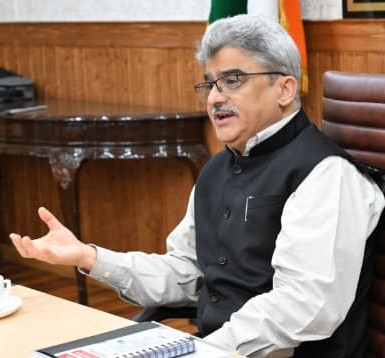
SRINAGAR, SEPTEMBER 30: Chief Secretary, Atal Dulloo took a comprehensive review of the public grievance redressal mechanism across Jammu and Kashmir, with particular emphasis on assessing the quality of grievance disposal, the average time taken by departments and districts to resolve public complaints and the level of satisfaction among complainants.
The meeting besides Commissioner Secretary, DoPG was attended by Administrative Heads of other Departments; Divisional Commissioner, Jammu/ Kashmir; Deputy Commissioners; SIO, NIC; HoDs of Departments and a team from BISAG-N too.
The review focused on evaluating the responsiveness of different departments and district administrations, identifying areas requiring improvement and exploring technological interventions to make the existing grievance redressal mechanism more efficient, transparent and citizen-centric.
While speaking the Chief Secretary remarked that the success of the grievance redressal mechanism should be measured by the quality of grievance resolution and the satisfaction of the complainants. He enjoined that it is paramount for every department and district administration to resolve public grievances promptly, effectively and to the satisfaction of the citizens.
On departmental accountability and citizen feedback he maintained that the citizen feedback should serve as an important benchmark for assessing the performance of departments and districts. He stressed on the need to identify the causes of delays, address recurring grievances stating that our ultimate objective is to strengthen public trust in the responsiveness of the administration.
During the meeting, the Commissioner Secretary, Public Grievances, Saurabh Bhagat presented a detailed assessment of the functioning of JK Samadhan and the Centralised Public Grievance Redress and Monitoring System (CPGRAMS), covering cumulative grievance disposal, department-wise and district-wise performance, urgent complaints, citizen feedback and household registrations on the portal.
The presentation revealed that a cumulative 1,60,685 grievances had been received through the two platforms as of September 25, 2026. Of these, 1,36,977 grievances had been redressed or closed, reflecting an overall disposal rate of 85 percent, while 23,708 were under process.
JK Samadhan alone accounted for 1,40,101 grievances, of which 1,24,534 had been disposed of, achieving a disposal rate of 89 percent. The remaining 15,567 grievances were under process. CPGRAMS recorded 20,584 grievances, with 12,443 disposed of and 8,141 awaiting resolution.
A significant part of the review centred on citizen feedback and the effectiveness of the grievance redressal process. The Department presented an analysis of 5,239 responses, with further scope for enhancing the quality and timeliness of grievance resolution.
Regarding the expansion of the platform’s reach, it was informed that 15,75,457 households had been registered on JK Samadhan against a target of 22,49,631 households across J&K, achieving an overall coverage of 70 percent as of September 24, 2026.
The Department also presented its roadmap for upgrading JK Samadhan through technological interventions aimed at enhancing the quality, accessibility and efficiency of grievance redressal.
It was informed that the Department had initiated the process for an MoU to replicate relevant features of Rajasthan’s grievance redressal model in Jammu and Kashmir to enhance the functionality and productivity of the portal.
Besides, the Department is working with BISAG-N to introduce artificial intelligence-based features and predictive analytics to strengthen grievance management and enhance citizen satisfaction. Technical issues faced by departments and users are also being regularly taken up with BISAG-N for resolution.
Another major initiative outlined during the presentation was the proposed integration of JK Samadhan 2.0 with WhatsApp, enabling citizens to access grievance redressal services through a familiar and widely used messaging platform.
The review placed particular emphasis on improving the effectiveness of the existing grievance redressal mechanism by addressing delays, strengthening departmental responsiveness and ensuring that the disposal of complaints results in meaningful resolution of citizens’ concerns.

