

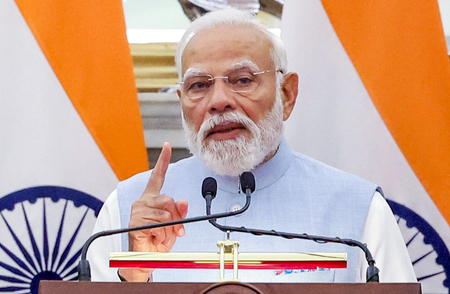
Distributes over 51k appointment letters
New Delhi: Prime Minister Narendra Modi on Saturday said India’s “Yuva Shakti” is at the heart of the country’s journey towards becoming a developed nation by 2047, calling upon young government employees to use their skills, authority and decisions to advance the aspirations of the country’s youth.
Modi made the remarks while distributing more than 51,000 appointment letters to newly appointed youth in various government organisations at the 20th Rozgar Mela through video conferencing. He said the occasion marked a new beginning for thousands of young people and their families, while underscoring the responsibility of the new recruits towards the nation.
Welcoming the appointees to the Government of India, Modi said the youth would have a pivotal role in strengthening the twin objectives of a developed and self-reliant India. He said the talent and skills of Indian youth had earned global recognition and that the world had high expectations from the country’s innovators, entrepreneurs and young people.
The Prime Minister said the responsibility of the new officials went beyond routine administration, urging them to ensure that every administrative decision helped remove hurdles for young people, encouraged innovation and facilitated investment and employment.
“Your signature on every file should be one that advances youth aspirations,” Modi said, stressing that the functioning of government must continuously evolve to meet the changing needs of citizens and the economy.
Referring to India’s growing engagement with the global economy, Modi said initiatives under BRICS, including BRICS CONNECT and the BRICS MSME Cooperation Portal, were aimed at bringing entrepreneurs, farmers, women and youth into international partnerships.
He also said Free Trade Agreements with around 40 countries were opening new markets and creating opportunities for domestic entrepreneurs and the youth.
Modi highlighted the government’s focus on future-ready skills through initiatives including the National Education Policy, Skill India Mission, Pradhan Mantri Kaushal Vikas Yojana and apprenticeship programmes.
He said the PM-SETU scheme was aimed at modernising 1,000 government Industrial Training Institutes with an investment of Rs 60,000 crore and greater participation from industry.
“Our endeavour is that the education and skills of the youth keep pace with the needs of the changing economy,” he said.
The Prime Minister also highlighted the expansion of India’s startup ecosystem, describing the country as the world’s third-largest startup ecosystem. He said nearly half of all recognised startups were now based in Tier-2 and Tier-3 cities, reflecting the growing participation of youth from smaller towns and cities in entrepreneurship and the new economy.
“Today the youth from villages, towns, and small cities are also playing a major role in India’s new economy,” Modi said.
On employment generation, Modi highlighted the Pradhan Mantri Viksit Bharat Rojgar Yojana, a Rs 1 lakh crore initiative aimed at bringing two crore youth into the formal workforce for the first time.
Under the scheme, first-time employees can receive incentives of up to Rs 15,000, while employers creating new jobs are also eligible for financial incentives.
Modi said employment opportunities were closely linked to economic growth, investment and expansion of industries. He cited a 7.8 per cent growth rate and a 12 per cent rise in investment during the first quarter, saying reforms undertaken in recent years had contributed to the country’s economic performance.
He called for continued reforms in taxation, ease of doing business, education and skilling, as well as opening new sectors to innovation.
“It is necessary that the Reform Express in the country runs continuously at full speed,” Modi said, addressing the newly appointed officials.
The Prime Minister also urged the recruits to use their own experiences of facing difficulties before entering government service to make the system more accessible for other young people.
He said their objective should be to ensure that the problems they had encountered did not have to be faced by others seeking government services and opportunities.
Modi further called upon the new recruits to continuously upgrade their skills and adapt to emerging technologies through the Mission Karmayogi framework. He said the ‘Karmayogi Prarambh’ module had been designed to help new entrants understand the functioning of government, while around 1.7 crore employees were already on the iGOT platform.
Emphasising the importance of public trust in governance, Modi said the daily work of government employees directly affected citizens, whether through pensions, scholarships, farmer subsidies or other public services.
He said the behaviour, sensitivity, efficiency and honesty of government employees would shape citizens’ experience with the state.
Concluding his address, Modi called upon the new officials to follow the principle of “Nagrik Devo Bhava” — the citizen is divine — and treat public service as national service.
He said the success of the new recruits would be measured not merely by their professional achievements but by their ability to make the lives of citizens easier.

