

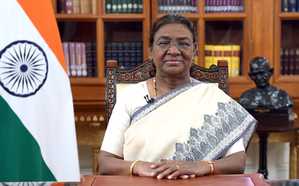
Calls teachers ‘lifeblood’ of education system
New Delhi: President Droupadi Murmu on Saturday said education is the most effective means of translating the constitutional ideal of equality of opportunity into reality and called for ensuring that not a single student is deprived of access to quality education.
Conferring the National Teachers Awards on 48 educators at Vigyan Bhawan here on Teachers’ Day, Murmu said teachers were the “lifeblood” of the education system and had a special responsibility to nurture children academically, physically and morally.
She said school education forms the foundation of the education system and that while knowledge and skills can be acquired at any stage, teaching children good conduct during their formative years is particularly effective.
“By diligently focusing on the intellectual, physical and moral development of children in the early grades,” teachers can prepare future generations of good students and dutiful citizens, she said.
The President emphasised that a student’s behaviour often leaves a deeper impression than the curriculum taught by a teacher.
“Students are the identity of teachers. Students may forget the curriculum taught by their teachers, but they will always remember their behaviour,” she said.
Murmu drew attention to students from economically weaker families, first-generation learners, children moving from ordinary village schools to large city schools, naturally shy students, talented children lacking self-confidence and children with special needs.
She said helping such students overcome their sense of inadequacy and building their confidence was a special responsibility of teachers.
Explaining the meaning of the Sanskrit word uddhar, which refers to pulling someone out or lifting them upwards, Murmu said teachers have the unique opportunity to “uplift” their students and help them move forward.
The President said India had made significant progress in reducing school dropouts. She noted that the primary school dropout rate was around 4.5 per cent 12 years ago and had now become almost negligible, crediting teachers for the achievement.
“I appreciate all teachers for this national success,” she said.
Calling for a world-class education system to realise the goal of a Viksit Bharat, Murmu said India must ensure that every child has access to good educational opportunities.
“Our teachers breathe life into the education system,” she said, urging them to impart knowledge, inspiration, morality and sensitivity to all students through affection and dedication.
Sharing a personal connection with the occasion, Murmu said being among teachers brought out both the student and teacher in her.
She recalled her own teachers and said their affection and guidance had helped her reach where she was in life.
The President also remembered the students she had taught at the Sri Aurobindo Integral School in Rairangpur, Odisha, saying she had learnt a great deal from them.
She described the love she received from her students as one of the greatest achievements of her life and said her own experience as a member of the teaching community made the occasion particularly meaningful for her.
Murmu also paid tribute to Savitribai Phule, whom she described as the first Indian woman teacher to teach in a school in the modern era.
She recalled Phule’s pioneering work for girls’ education and the establishment of girls’ schools in the 19th century, and paid homage to her contribution.
The President also recalled the educational experiments of Rabindranath Tagore and freedom fighter Gopabandhu Das, who established Shantiniketan in West Bengal and an open-air school in Odisha respectively. She said these institutions were founded on the idea that children could develop naturally in the lap of nature.
Murmu noted that the awardees represented the breadth of India’s education system, from Ladakh to the Andaman and Nicobar Islands and from Arunachal Pradesh to Gujarat.
She expressed particular happiness that a large number of the awardees were teachers from village schools and hoped their teaching and training methods and achievements would inspire other educators to pursue excellence.
Referring to films showcasing the awardees’ work, she said they strengthened her belief that dedicated teachers are “frontline nation-builders”.
She cited the example of a village school in Rajasthan’s Jhalawar district, where students, under their teacher’s guidance, were studying biology using highly modern methods.
The example, she said, demonstrated that with big ideas, even teachers and curious students in the smallest of places can create modern, high-quality examples of teaching and learning.
Academic excellence, skills and entrepreneurship
Murmu said academic excellence, skill development and entrepreneurship were of great importance to India’s development.
She said making India a knowledge superpower as well as the “skill capital of the world” was among the country’s national priorities.
Referring to India’s historic centres of learning, she cited accounts of Nalanda and Vikramshila and highlighted the reputation of their teachers, who attracted students from distant countries.
She also recalled Nobel laureate C.V. Raman’s teaching methods, saying he engaged closely with students and encouraged them to pursue questions beyond textbooks and explore the original works of great scientists.
The National Teachers Awards are organised annually by the Department of School Education and Literacy under the Ministry of Education to recognise educators for exceptional commitment, innovation and contribution to school education.
This year, 48 school teachers were selected through a three-stage process at the district, state and national levels. The awardees represent 27 States, seven Union Territories and six Central Government organisations, with 26 men and 22 women among them.
Short documentaries highlighting the work and achievements of each awardee were also screened during the ceremony, showcasing their contribution to students and their communities.

