

Hails SANJY-2026 Waste Management
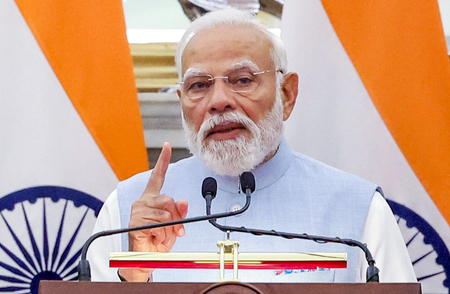
New Delhi: Prime Minister Narendra Modi on Sunday highlighted the sanitation and scientific waste management arrangements made during the recently concluded Shri Amarnath Ji Yatra, praising the efforts of sanitation workers, pilgrims and other stakeholders in maintaining cleanliness along the challenging Himalayan pilgrimage route.
Addressing the 137th episode of ‘Mann Ki Baat’, Modi said the Yatra witnessed inspiring examples of cleanliness and public participation. He said more than 400 metric tonnes of waste were collected and processed during this year’s pilgrimage.
The Prime Minister said thousands of sanitation workers worked day and night to serve pilgrims along the arduous routes, while pilgrims themselves became active participants in the cleanliness drive.
According to Modi, more than 16,000 pilgrims took a cleanliness pledge, while over 10,000 were awarded the ‘Responsible Yatri’ certificate.
He particularly highlighted an initiative under which dung generated by horses and mules used during the pilgrimage was converted into biogas. The clean energy generated through the process was used to light the ‘Swachh Jyot’.
“In essence, cleanliness became a form of service and faith during this holy pilgrimage to Baba Barfani,” Modi said.
The Prime Minister also cited the example of Patwai village in Rampur, Uttar Pradesh, where two youths, Akash and Rohan, launched the ‘Clean-up Patwai’ initiative after noticing garbage in their locality. The initiative later attracted other young people, with the group cleaning four Ganga ghats and removing more than a tonne of plastic waste besides cleaning ponds and public spaces.
Modi said the identity of villages, cities, rivers and pilgrimage sites is shaped by people’s conduct and that making cleanliness part of everyday conduct enhances their beauty.
During the episode, the Prime Minister also spoke about several grassroots initiatives, including Mumbai-based Krishna Seshadri’s website ‘Bharat Rajya’, which uses technology to make Indian history more accessible and engaging. Seshadri told Modi that his interest was driven by a desire to present India’s history as a story and draw attention to lesser-known dynasties such as the Cholas, Pallavas, Karkota dynasty of Kashmir and Ahoms.
Modi also called for greater public participation in the ‘Nasha-mukt Yuva for Viksit Bharat’ campaign and urged young musicians, students, theatre groups and content creators to use their creativity to spread awareness about drug addiction.
Highlighting women’s economic empowerment, he said women account for around 46 per cent of beneficiaries under PM SVANidhi, with around 35 lakh women using the scheme to expand their street-vending businesses.
He also highlighted examples of women entrepreneurs Babita Sharma of Ghaziabad and T.S. Ningamma of Bengaluru, whose businesses expanded with financial assistance under PM SVANidhi.
The Prime Minister further spoke about flower cultivation by Vesalu Puro of Nagaland, forest conservation by women associated with Debrigarh Eco-Tourism in Odisha, and emerging opportunities for farmers through avocado cultivation in Andhra Pradesh, Tamil Nadu and Karnataka.
On space education, Modi highlighted ‘Mission ShaktiSAT’, under which 12,000 girl students from 108 countries are being given an opportunity to learn satellite technology and innovation. He said preparations are underway to send a satellite developed through the participation of female students into lunar orbit.
Recalling legendary actor Uttam Kumar ahead of his birth centenary on September 3, Modi paid tribute to the actor’s contribution to Indian cinema and recalled his perseverance despite initial setbacks.
With festivals including Janmashtami and Vishwakarma Puja approaching, Modi once again appealed to citizens to embrace ‘Vocal for Local’ and prefer products made in India, saying such choices would contribute to the country’s journey towards self-reliance.

