

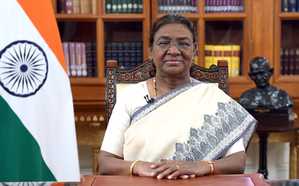
‘Op Sindoor sent strong message to terrorists’
New Delhi: President Droupadi Murmu on Friday strongly defended the suspension of the Indus Waters Treaty with Pakistan, calling it a “decisive step” in the national interest, and said Operation Sindoor had sent a clear message that terrorists and those supporting them would face the consequences of their actions wherever they hide.
In her address to the nation on the eve of the 80th Independence Day, Murmu said India had demonstrated its military capability and resolve against terrorism while continuing its march towards becoming a developed nation by 2047.
Recalling the completion of one year of Operation Sindoor on May 7, the President said the operation showcased the Indian Armed Forces’ ability to carry out precise strikes against terrorism.
“That historic operation against terrorism demonstrated the capability of the Indian Armed Forces to act with precision. It sent a clear and firm message to terrorists and those who support them, that no matter where they hide, they will have to face the consequences of their actions,” she said.
Referring to the suspension of the Indus Waters Treaty, Murmu termed it a significant national decision. “Suspension of the Indus Waters Treaty with the country that harbours terrorism is a decisive step in the interest of our nation, especially the farmers,” she said.
The President said India was progressing steadily towards the goal of becoming a “Viksit Bharat” by the centenary year of Independence in 2047, guided by the principle of Antyodaya to ensure that the benefits of development reach every citizen.
Paying tributes to freedom fighters, Murmu remembered Mahatma Gandhi, Dr B R Ambedkar and other leaders who guided the country to freedom. She also recalled the sacrifices made during Partition on Vibhajan Vibheeshika Smriti Divas and paid homage to Sardar Vallabhbhai Patel for integrating more than 550 princely states into the Indian Union.
Highlighting India’s democratic traditions, she said people’s participation remained the foundation of governance and development. She stressed that the Constitution guaranteed equality, dignity and opportunity for all citizens and underscored the responsibilities of the legislature, executive and judiciary in serving the people and ensuring access to justice.
The President said the country had witnessed rapid and inclusive development over the past decade, with priority given to harmonising heritage and development while removing long-standing obstacles to growth. She said more than 25 crore people had been lifted out of poverty, nearly 59 crore people had joined the banking system under the Jan Dhan Yojana, and over 80 crore citizens were receiving food security benefits through free ration schemes.
She also highlighted the Ayushman Bharat scheme, which provides annual health coverage of up to Rs 5 lakh to around 60 crore people, and said various initiatives, including Kisan Samman Nidhi and Kisan Credit Cards, had strengthened the farming community.
Murmu said India had built the world’s largest digital infrastructure, with more than half of global real-time digital transactions taking place in the country. She noted that digital technology had improved transparency in welfare delivery and transformed everyday life, including in rural areas.
The President said unprecedented expansion of highways, waterways, railways and air connectivity had created employment opportunities, encouraged investment and accelerated economic activity. Despite global conflicts and instability, she said India remained the world’s fastest-growing major economy, with projected growth more than twice the global average.
On the international front, Murmu said India’s foreign policy was anchored in national interest, peace, cooperation and the principle of Vasudhaiva Kutumbakam. She said India was playing a leading role among Global South nations, expanding economic ties through free trade agreements and advocating greater representation for developing countries in global institutions, including the United Nations.
The President also stressed environmental protection, saying future generations had an equal right over natural resources. Referring to initiatives such as Ek Ped Maa Ke Naam and the Lifestyle for Environment (LiFE) campaign, she urged citizens to make both individual and collective efforts to conserve nature.
Highlighting women’s empowerment, Murmu said women were excelling in education, agriculture, entrepreneurship, defence and sports. She noted that women won eight of India’s 13 gold medals at the recently concluded Commonwealth Games in Glasgow and said the target of creating three crore “Lakhpati Didis” had been achieved, with a fresh goal of creating three crore more.
She also referred to the Nari Shakti Vandan Adhiniyam, enacted in 2023 to reserve 33 per cent seats for women in the Lok Sabha and state legislatures, saying it would make democracy more inclusive and strengthen women’s leadership.
Describing India’s youth as the country’s greatest asset, Murmu said 65 per cent of the population was below the age of 35. She praised young innovators, entrepreneurs and scientists, citing a recent successful rocket launch carried out by a team with an average age of just 28 years. She said India’s growing startup ecosystem reflected the creativity and ambition of its youth.
The President also called for reforms to make public examinations more secure, transparent and trustworthy, while stressing the importance of physical and mental wellbeing among young people. She said government investments in sports and the Khelo India programme were producing encouraging results at the international level.
Murmu further highlighted welfare measures for senior citizens, including free healthcare coverage of up to Rs 5 lakh annually for citizens aged 70 years and above, and urged society to ensure their dignity and wellbeing.
She also hailed the inclusion of 12 Maratha forts and Sarnath in UNESCO’s World Heritage List, saying the recognitions reflected India’s rich civilisational heritage and enduring traditions.
Calling for collective efforts towards nation-building, the President said the development and wellbeing of every Indian remained the central objective of the Viksit Bharat mission and urged citizens to dedicate themselves to transforming India into a developed, prosperous and inclusive nation by 2047.

