

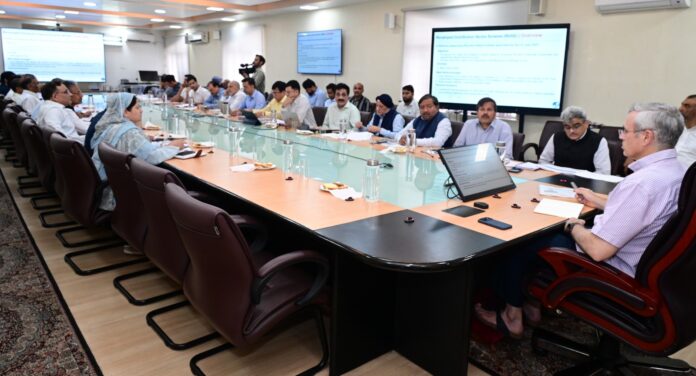
SRINAGAR, JULY 06: Chief Minister Omar Abdullah Monday chaired the 13th meeting of the Executive Council of the Institute of Management, Public Administration & Rural Development (IMPARD) at the Civil Secretariat, reaffirming the Government’s commitment to strengthening institutional capacity, administrative excellence and good governance across Jammu and Kashmir.
The meeting comprehensively reviewed the functioning of IMPARD and deliberated on a wide range of measures aimed at enhancing the institute’s role as the premier training and capacity-building institution for J&K’s civil services.
The meeting was attended by Chief Secretary Atal Dulloo, Additional Chief Secretary to the Chief Minister Dheeraj Gupta, Additional Chief Secretary, Finance Shailendra Kumar, Commissioner Secretary General Administration Department M Raju, Director General IMPARD Rehana Batul and other senior officers.
At the outset, Director General IMPARD Rehana Batul presented a detailed overview of the institute’s functioning, ongoing initiatives and future roadmap. She placed the agenda items before the Executive Council, which discussed each proposal extensively before taking considered decisions.
As Chairman of the Executive Council, the Chief Minister engaged in deliberations on important institutional matters, including recruitment of faculty members, finalisation of new recruitment rules, review and strengthening of training programmes, and support needed for organisation’s long-term growth and sustainability.
The Council also examined various employee-related issues, including welfare measures, deputation of faculty members to fill up key positions at IMPA in the short term, implementation of career advancement, service matters, compassionate appointments, engagement of consultants and examination of other proposals through the designated sub-committee. The EC observed that these measures shall strengthen the institutional framework and ensure greater operational efficiency.
Emphasising the pivotal role of IMPARD in nurturing a professional and accountable civil service, the Chief Minister stressed the need for continuous institutional reforms, high-quality training and innovation in public administration. He underscored that a modern governance framework requires well-trained, motivated and future-ready public servants capable of responding effectively to emerging challenges and citizens’ expectations.
The Chief Minister called for regular upgradation of training modules in line with evolving governance practices, greater adoption of technology-enabled learning and stronger knowledge partnerships to ensure that government officials remain equipped with the skills required for efficient public service delivery.

