

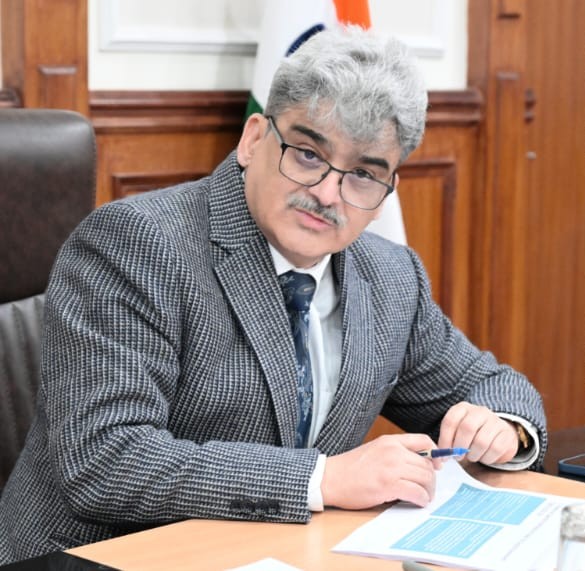
Calls for NABH accreditation, universal NQAS certification
SRINAGAR, MAY 11: Chief Secretary, Atal Dulloo Monday chaired a comprehensive review meeting of the National Health Mission (NHM) and allied healthcare programmes in Jammu and Kashmir and took stock of the achievements, challenges and future roadmap of the Health & Medical Education Department for strengthening healthcare delivery across the Union Territory.
The meeting, besides Commissioner Secretary, Health & Medical Education, was attended by MD, NHM; Director, SKIMS; Principals of Government Medical Colleges; Director, Health Services, Jammu/Kashmir, besides other concerned officers.
During the meeting, the Chief Secretary stressed the need for further strengthening healthcare systems and directed that premier healthcare institutions in Jammu and Srinagar should immediately initiate the process for securing NABH accreditation.
He instructed each Medical College in these cities to designate a nodal officer for ensuring institutional preparedness and observed that other Medical Colleges and District Hospitals should subsequently follow the same model to improve quality standards and patient care services across the UT to get accredited under NABH framework.
Emphasizing the need for equitable healthcare access, the Chief Secretary directed the department to ensure posting of at least one Medical Officer in every Primary Health Centre and reiterated that no health institution across Jammu and Kashmir should remain without a doctor.
He also called for expediting the tendering process for establishment of Tele-ICU, Tele-Radiology and BEMMP facilities, stating that these initiatives would significantly strengthen tertiary care delivery and enable patients to avail advanced healthcare services closer to their homes.
Reviewing quality assurance measures, the Chief Secretary directed the Directors of Health Services to ensure certification of all health facilities under the NQAS framework within the current year. He stressed that quality certification and adherence to healthcare standards are essential for improving service delivery and public confidence in government healthcare institutions.
The Chief Secretary also reviewed the ongoing screening of the population for Non-Communicable Diseases (NCDs) and emphasized intensifying efforts for screening people above 40 years of age. Describing NCDs as silent killers, he warned that these ailments could assume alarming proportions if neglected and underscored the importance of promoting lifestyle modifications and preventive healthcare measures among the general public.
He further called for strengthening Drugs & Vaccine Distribution Management System (DVDMS) to improve availability of drugs under the Essential Drug List across healthcare institutions.
The Commissioner Secretary, Health & Medical Education, M. Raju, during the meeting elaborated upon the steps taken by the department for implementation of the directions issued previously and also gave a detailed overview of the progress achieved under various programmes being implemented under NHM.
He maintained that Jammu and Kashmir has registered remarkable improvement in major healthcare indicators and has already achieved the Sustainable Development Goal targets for Neonatal Mortality Rate and Under-Five Mortality Rate besides meeting several National Health Policy targets ahead of schedule.
Mission Director, NHM, Akriti Sagar apprised the meeting that significant improvement has been recorded in Neonatal Intensive Care Units (NICUs) and Sick Newborn Care Units (SNCUs), where the successful discharge rate of neonates increased from 76 percent during 2024-25 to 83 percent in 2025-26, while neonatal deaths and referrals to higher institutions have shown a decline.
Reviewing the Rashtriya Bal Swasthya Karyakram (RBSK), she informed the meeting that more than 18.84 lakh children had been screened under the programme during the current financial year while over 1.51 lakh children requiring treatment were referred to higher healthcare institutions.
The review further highlighted remarkable institutional delivery coverage in the UT, with nearly 99.82 percent deliveries during 2025-26 taking place in health institutions, reflecting improved maternal healthcare outreach and accessibility. Under Janani Shishu Suraksha Karyakram (JSSK), more than 1.61 lakh pregnant women were provided free drugs and consumables while over 1.46 lakh women received free diet during hospitalization.
The meeting was also informed that Jammu and Kashmir has emerged as the top-performing region in the country in X-Ray utilization under the TB Mukt Bharat Abhiyaan 2.0 campaign. A total of 1,518 high-risk villages have been identified for intensified TB screening through special shivirs and the UT has already organized 333 screening camps with participation of more than 30,000 people.
It was informed that five districts including Anantnag, Budgam, Kulgam, Pulwama and Shopian have been declared TB-free, while more than 5,500 TB patients are currently undergoing treatment in the UT with all patients linked to designated doctors for regular monitoring and treatment supervision.

