

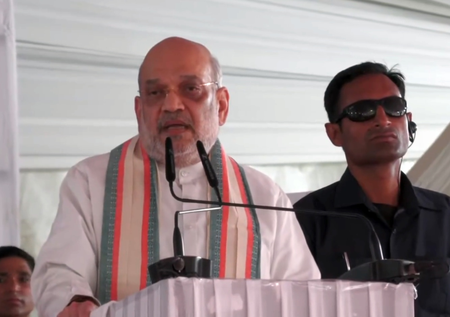
Leh, May 1: Union Home and Cooperation Minister Amit Shah on Friday highlighted major improvements in Ladakh’s connectivity infrastructure, reporting a sharp decline in winter closure days on key routes and progress on strategic tunnel projects aimed at ensuring all-weather access to the Union Territory.
Addressing a gathering in Leh, Shah said the Zoji La Pass—a critical gateway to Ladakh—remained closed for only 19 days this year, compared to 127 days in earlier years. Similarly, the Kargil–Zanskar road, which earlier remained shut for around 154 days annually, was closed for just 11 days this year.
He attributed the improvement to enhanced snow-clearance capacity and infrastructure upgrades, including a significant increase in the number of snow removal machines deployed across the region.
Shah said work on the strategic Zoji La tunnel is currently underway, while construction of the Shinkula Tunnel has begun. These projects, he said, are expected to provide all-weather connectivity, reduce travel disruptions due to extreme weather, and strengthen access to border areas.
The Home Minister said the connectivity gains form part of a broader infrastructure push in Ladakh since it became a Union Territory in 2019. He said road length in the region has increased from 1,800 km to 4,040 km, while the number of bridges has risen from 19 to 72. Mobile towers have increased from 344 to 653, and helipads from 7 to 41, improving both civilian and strategic mobility.
He added that electrified villages have increased from 145 to 184, while distribution transformers have risen from 1,182 to 3,153. Snow clearance machinery has expanded from just 7 units earlier to 215 at present, enabling faster restoration of road connectivity during harsh winters.
Shah said a new civilian airport is under construction, and VSAT connectivity has been extended to all panchayats, alongside major upgrades to 4G telecom infrastructure. He also highlighted developments in education, including the establishment of Sindhu Central University and the setting up of 174 ICT labs, 230 smart classrooms, 40 astronomy labs and 24 Atal Tinkering Labs.
He said under the Jal Jeevan Mission, nearly 98 per cent of households in Ladakh have been provided tap water connections, and the region is on track to become a fully literate administrative unit.
Referring to administrative changes, Shah said Ladakh now has seven districts and 193 panchayats, with five new districts—Sham, Nubra, Changthang, Zanskar and Drass—recently notified. He added that local languages including Bhoti, Purgi, Urdu, Hindi and English have been accorded administrative importance.
The Home Minister said Ladakh’s budget has increased from ₹1,000 crore when it was part of Jammu and Kashmir to ₹6,000 crore at present. He also noted the establishment of the Sindhu Infrastructure Development Corporation to accelerate industrial growth in the region.
Shah said the government’s focus is to make Ladakh self-reliant while strengthening its strategic and economic infrastructure. He also acknowledged the contribution of Ladakh’s residents in safeguarding the country’s borders, stating that the nation remains grateful for their role and sacrifices.

