

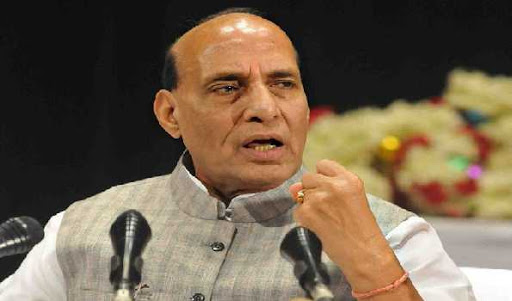
New Delhi, Apr 30: Defence Minister Rajnath Singh on Thursday said India is globally recognised for Information Technology, while Pakistan has become the epicentre of “International Terrorism”, asserting that the country has moved beyond “mere diplomatic responses” to terror attacks and now responds with decisive action.
Addressing a National Security Summit, Singh said Operation Sindoor sent a clear global message that India is no longer bound by the old approach of issuing statements after attacks. He said the government led by Prime Minister Narendra Modi has demonstrated its resolve through firm and calibrated action.
“Operation Sindoor conveyed an unequivocal global message that India is no longer bound by the old mindset of merely issuing diplomatic statements when terror attacks are perpetrated on its soil. The Government has moved beyond intent and rhetoric, demonstrating its unwavering commitment through decisive action,” he said.
He asserted that the Government has maintained a firm stance that any act of terrorism, under any circumstances, will not be tolerated. He described the surgical strikes, air strikes and Operation Sindoor as manifestations of the Government’s resolute stand against the menace.
“Terrorism emanates from a distorted and perverse mindset. It casts a dark stain on humanity. The battle against terrorism is not merely a matter of national security; it is fundamentally a battle to safeguard the core values of humanity. It is a fight against a barbaric ideology that stands in direct opposition to every human value. We have articulated this Indian perspective both within the country and abroad,” he said.
The Defence Minister added that as long as terrorism exists, it will continue to challenge collective peace, development and prosperity. “Attempts are made to justify terrorism by giving it a religious colour or linking it to violent ideologies such as Naxalism. This is extremely dangerous and, in a way, provides cover to terrorists to advance towards their goals. Terrorism is not just an anti-national act; it has multiple dimensions—operational, ideological and political. It can only be tackled by addressing all these dimensions,” he said.
On Pakistan, Singh said: “Both India and Pakistan attained independence at the same time. However, today India is recognised globally for IT, i.e. ‘Information Technology’, while Pakistan is regarded as the epicentre of a different IT, i.e. ‘International Terrorism’.”
He termed Operation Sindoor a shining example of jointness and synergy among the Indian Armed Forces. The Indian Army, Indian Navy and Indian Air Force acted in concert under a unified plan, demonstrating that India’s military no longer operates in silos but has emerged as a joint, integrated and modern force.
Singh said India executed Operation Sindoor on its own terms and at a time of its choosing, and halted it strictly on its own terms. “During the operation, we targeted with absolute precision only those who had perpetrated the attack against us. We did not halt the operation due to any limitation in capability. We were fully prepared to sustain a prolonged conflict, with the requisite surge capacity to rapidly scale up operations during crises,” he said.
He underlined that India’s military-industrial complex has consistently demonstrated readiness to meet both peacetime requirements and wartime logistical demands. He added that India did not succumb to nuclear threats and successfully achieved its objectives. “This is the ‘New India’ in the evolving global order—an India that makes no distinction between terrorists and those who sponsor them,” he said.
Describing Operation Sindoor as an embodiment of deterrence, Singh said that although the operation concluded within 72 hours, the preparatory groundwork was extensive. He highlighted India’s surge capacity, rapid mobilisation capabilities, strategic stockpiles and the growing credibility of indigenously developed weapons as key elements of its deterrence posture.
He added that a shift in global perception towards the reliability of indigenous defence products is being witnessed following Operation Sindoor. “In FY 2025–26, defence exports reached a record Rs 38,424 crore, registering a surge of 62.66 per cent over the previous fiscal. We remain committed to surpassing these benchmarks,” he said.
Referring to his recent visit to Germany, the Defence Minister said major European companies are keen to collaborate with India’s private defence firms and public sector units, reflecting growing global confidence in India’s capabilities.
Highlighting the changing nature of deterrence, Singh said the cyber domain, space warfare and information technology have become critical, with Artificial Intelligence (AI) at the centre of this shift. From missile systems like BrahMos to surveillance platforms, AI has enhanced precision and strike capabilities, he noted.
Underscoring AI’s practical applications, he said it is playing a key role in identifying terrorists and enabling decisive responses. “AI also stands for ‘Augmented Infantry’ and is significantly enhancing troop capabilities. We are transforming our military into a technology-driven, integrated fighting force with agile units such as ‘Rudra’ Brigades, ‘Bhairav’ Battalions, ‘Shaktibaan’ Artillery Regiments and ‘Divyastra’ Batteries,” he said.
He added that AI is also improving the working culture and welfare of soldiers. Referring to the SPARSH portal for defence pensioners, he said AI-enabled systems have simplified processes ranging from grievance redressal to medical record management.
Stressing that AI is central to India’s strategic preparedness, Singh said the Government is promoting nationwide AI development through the ‘IndiaAI’ Mission. “We are democratising computing infrastructure, enabling youth across the country to participate. Initiatives such as expanded GPU capacity, FutureSkills programmes and Data and AI Labs underline our commitment to this technological revolution,” he said.
However, he cautioned that AI also presents challenges such as deepfakes, cyber warfare and autonomous weapons. “If left unchecked, AI could become a tool of destruction. We must ensure it remains a force for good through collective efforts and international cooperation,” he said.
He added that AI applications across battlefield surveillance, autonomous systems, logistics optimisation and command support are being actively studied. Systems like the Sudarshan Air Defence project demonstrate the integration of AI, machine learning and big data in strengthening defence capabilities.
Defence Secretary Rajesh Kumar Singh, DRDO Chairman Dr Samir V Kamat and Chief of Integrated Defence Staff Air Marshal Ashutosh Dixit were also present at the event.

