

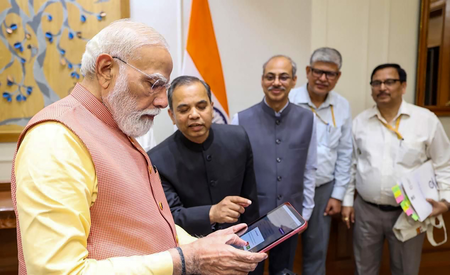
Prez, PM, HM complete self-enumeration
New Delhi: India on Wednesday launched Census 2027, the world’s largest enumeration exercise, with the rollout of Phase I—Houselisting and Housing Census (HLO)—marking the country’s first fully digital census with a self-enumeration facility.
President Droupadi Murmu became the first citizen to complete self-enumeration, continuing the tradition of initiating the national count at the highest office. Vice-President C. P. Radhakrishnan, Prime Minister Narendra Modi and Union Home Minister Amit Shah also completed their enumeration online.
In a post on X, PM Modi said he had completed his self-enumeration and urged citizens to participate. “This census is the first time data collection is being done through digital means… I appeal to the people of India to self-enumerate their household details,” he said.
The exercise, conducted under the Census Act, 1948, replaces the traditional paper-based system followed for over 150 years with digital data capture and a web-based self-enumeration option. The portal allows citizens to submit household details in advance of enumerators’ visits, with support for multiple Indian languages.
The first phase focuses on housing conditions, assets and amenities through 33 notified questions. Self-enumeration has begun in select regions, including Andaman and Nicobar Islands, Goa, Karnataka, Lakshadweep, Mizoram, Odisha, Sikkim, and parts of Delhi (NDMC and Delhi Cantonment). Around 55,000 households used the facility on the first day, according to official data.
The HLO phase will run nationwide between April and September 2026, with each state and Union Territory conducting a 30-day field operation, preceded by a 15-day self-enumeration window. Door-to-door enumeration will follow self-reporting to verify submitted details.
Phase II—population enumeration—is scheduled for early 2027, with March 1, 2027 as the reference date.
Officials said the digital census aims to improve accuracy, reduce errors and deliver faster data for policymaking. Data collected will remain confidential and used only for statistical purposes, with systems secured through encryption and multi-factor authentication.
Census data remains a key input for governance, resource allocation and development planning for the next decade.

