

Move aims at crop diversification, climate resilience
By: Owais Gul
Srinagar: In a bid to scientifically assess the adaptability of rubber plantations beyond their conventional tropical habitats, the Rubber Research Institute of India (RRII), Kottayam, Kerala, which oversees the National Institute for Rubber Training (NIRT), has signed a Memorandum with the Himalayan Forest Research Institute (HFRI), Shimla, said M. Vasanthagesan, IRS, Executive Director, Rubber Board.
Vasanthagesan, was briefing a delegation of media persons from Srinagar during the ongoing tour organized by Press Information Bureau (PIB) Srinagar under Majid Pandit, Media & Communication Officer, PIB Srinagar and Conducting Officer of the tour.
During the visit to NIRT Kottayam, Vasanthagesan, accompanied by Priya Varma, Director Training, NIRT briefed the media persons about the rubber cultivation and other processes.
Sharing the details, Vasanthagesan stated that 65 per cent of the rubber production is being utilized for the manufacturing of tyres for vehicles, divulging the process from trees to the roads.
Furthermore, he informed the delegation that the RRII, and the HFRI have entered into a MoU to explore the feasibility of cultivating rubber in non-traditional agro-climatic zones of the country.
It is notable to mention here that the HFRI’s station is also in Ladakh.
The MoU reflects a forward-looking approach to crop diversification, climate resilience and sustainable livelihood opportunities beyond their conventional tropical habitats.
The Rubber Board is a statutory body constituted by the Government of India under the Rubber Act, 1947, and is tasked with the overall development of the rubber industry in the country.
As outlined by officials during the media interaction, India’s rubber sector is predominantly driven by small growers. Nearly 1.37 million small holdings, with an average size of 0.63 hectares, together constitute more than 92 per cent of the total area under rubber and contribute about 94 per cent of the country’s overall rubber production. At present, rubber is cultivated over approximately 9.39 lakh hectares nationwide, in addition to 537 estates that are each spread over more than 10 hectares.
Beyond cultivation, the rubber industry sustains a substantial downstream network comprising 8,840 dealers, 117 processors and 4,102 consumers. Rubber product exports are valued at Rs. 43,202 crore, highlighting the sector’s strong economic footprint. Officials noted that research aimed at assessing rubber cultivation in colder regions could further bolster the industry by unlocking new avenues for expansion, diversification and innovation.
Later, the delegation interacted with senior scientists including Dr. C. Narayanan, Senior Scientist and Officer-in-Charge, Germplasm Division; Dr. Kala, Officer-in-Charge, Biotechnology Division; Dr. Bindu Roy, Senior Scientist, Pathology Division; and Madhusoodhanan, Officer-in-Charge, Rubber Technology Division.
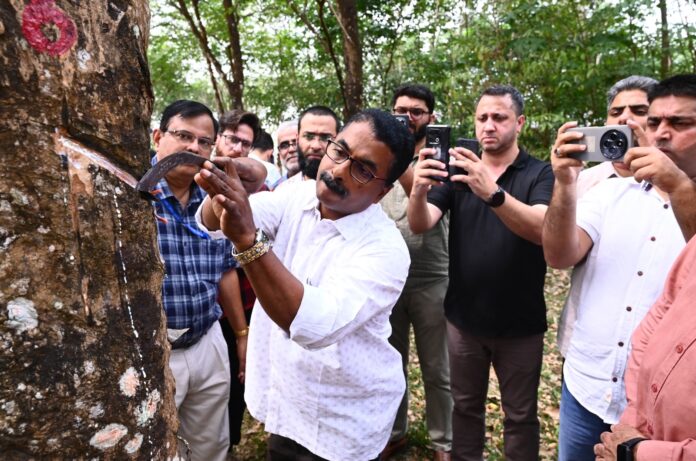
The delegation was given a practical demonstration of rubber tapping techniques. The team also visited the International Hevea Clone Museum at RRII, which serves as a repository of advanced genetic resources.

