

Preventive evacuations undertaken
Edu institutes to remain closed today
Relief centres set up across Srinagar
Srinagar/Jammu, Sep 3: The flood situation worsened significantly on Wednesday in Jammu and Kashmir, with nearly all rivers and streams flowing above the flood mark.
At 1 p.m., Chenab, Tawi, Ravi, Basantar, and Ujh rivers were flowing above the flood level in Jammu, and the Jhelum, Vishow, Sindh, Sheshnag, Lidder, and other streams and nallahs in Kashmir were fast reaching the flood mark.
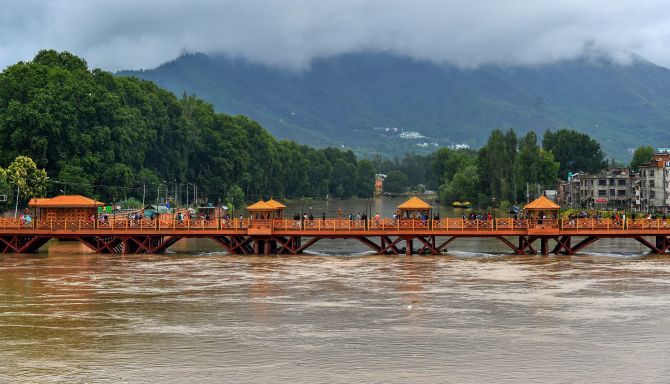
The Jhelum River was flowing close to evacuation level at Sangam in Anantnag district, while at Ram Munshi Bagh in Srinagar, the river was barely a foot lower than the flood mark.
The Vishow, Lidder, and Sheshnag streams were flowing higher than the flood level in south Kashmir, while the Sindh stream in North Kashmir was flowing close to the flood mark.
Continuous heavy downpour for the last two days has triggered flood-like situations in most parts of south Kashmir, inundating villages, damaging bridges, and leaving thousands of people stranded.
Standing crops, orchards, and residential structures have suffered extensive damage, while the administration has launched rescue and relief operations on a war footing.
Reports suggest some bridges in South and North Kashmir have been damaged by flood waters.
Flood waters from the Chenab River inundated many villages in the Akhnoor area of Jammu district as officials used loudspeakers to alert people in Jammu city to stay away from the Tawi River, which is in spate.
Chief Minister Omar Abdullah chaired a meeting to review the flood situation. Officials said he directed the administration to intensify ground response, ensure clearance of waterlogged areas, safeguard essential services, carry out timely evacuations in critical zones, and provide immediate relief.
Two ministers, Javed Rana and Satish Sharma, briefed him on the situation in Jammu, while Health Minister Sakina Itoo and advisor to the CM Nasir Sogami provided updates on the situation in Kashmir.
The Chief Minister appealed to the people to follow advisories and avoid vulnerable spots.
The Srinagar-Jammu highway, Mughal Road, and Sinthan Pass remained closed for the day as shortages of essentials of life triggered panic buying among people in the Valley.
Train services in the Jammu railway division remain severely disrupted after heavy rains and flash floods battered the region, causing extensive damage to the Pathankot-Jammu line.
The Northern Railway on Wednesday announced the cancellation of 68 incoming and outgoing trains from Jammu and Shri Mata Vaishno Devi Katra stations till September 30, even as 24 services are being gradually restored.
Officials said that rail traffic has been suspended for the past eight days due to breaches and track misalignments at several places on the Pathankot-Jammu section. The situation left scores of people, including Vaishno Devi pilgrims, stranded across the division.
“To facilitate stranded passengers, shuttle services have been pressed into service between Jammu Tawi and Shri Mata Vaishno Devi Katra. Additionally, long-distance trains, including Jammu Tawi-Kolkata and Katra-New Delhi, have been allowed to operate,” railway officials said.
Four trains have been inducted in the Jammu Katra section for shuttle service between September 1 and 15. The restored trains include Sampark Kranti, Sealdah Express, Kantri Express, Trivandrum Express and the popular Vande Bharat, which will resume operation from September 7.
Railways said that two pairs of shuttle services are now running daily between Jammu and Katra to cater to local commuters and pilgrims.
Officials added that so far, 5,784 stranded passengers have been transported in seven special trains from Jammu for their onward journey.
Despite the partial resumption, normalcy in rail operations is expected to take weeks, given the scale of damage.
Authorities have closed schools and colleges both in the Jammu division and the Valley for the day.
The Meteorological (MeT) department has forecast a gradual improvement in the weather beginning this evening.
Meanwhile as threat continued, the authorities started preventive evacuation of people from flood-prone areas in Anantnag, Kulgam, Pulwama, and Srinagar districts in the latter region.
In view of inclement weather and flood like situation, the government Wednesday said all educational institutes in Kashmir division shall remain closed on Thursday.
The government however said that the schools in Jammu division shall continue to remain closed till Friday.
Divisional Commissioner Kashmir Ashul Garg said that the government has decided to close the functioning of schools in Kashmir division on Thursday as a precautionary measure.
Garg said, “In view of adverse weather conditions, all educational institutions including schools, colleges, universities and private coaching centers in Kashmir shall remain closed tomorrow on 04.09.2025 as a precautionary measure.”
Meanwhile, Director Colleges in an order said that in view of the prevailing inclement weather conditions and as a precautionary measure to ensure the safety and security of students and staff across the Union Territory of Jammu and Kashmir, all Government Degree Colleges, GCETs, private colleges in the UT of J&K shall remain closed on September-04.
In the meantime, Director of School Education Jammu (DSEJ) in an order said that the schools across Jammu and division shall remain closed till September-05 in view of inclement weather and flood like situation.
“In reference to the weather alert issued by the IMD and also keeping in view the incessant rains, landslides, flash floods, and severe waterlogging in low-lying areas, all government and private schools across Jammu Division shall remain closed till 05-09-2025 to ensure the safety of students and staff,” DSEJ said.
The directorate further ordered that online classes shall be conducted wherever possible to maintain continuity of education.
The University of Kashmir officials also said that in view of adverse weather conditions, the university shall remain closed on Thursday. “All examinations scheduled for the day are postponed. The fresh dates will be notified separately
As a part of emergency preparedness plan, the Srinagar district administration on Wednesday evening established a network of ‘15 relief centres’ across the city, officials said.
They said these centres, along with deployed nodal officers and medical teams, are meant to ensure a quick and coordinated response in case of any eventuality.
According to an official order issued by the office of the Deputy Commissioner Srinagar, the relief centres have been set up at key locations including Ellahibagh Buchpora, Lalnagar Chanapora, Babdam, Khanyar, Barbarshah, Nowhatta, Raddapora, Palpora, Maloora, Zewan, and Khonmoh.
The order states that these facilities, established in community halls, schools, and panchayat ghars, will serve as safe shelters for affected families during emergencies.
The administration has also appointed officers from various departments — Revenue, Rural Development, Agriculture, Labour, Cooperatives, and District Industries Centre — as nodal officers for each centre.
Their mandate includes coordinating relief measures, maintaining communication with district control rooms, and ensuring adequate food, shelter and other essential services.
Further, the Health Department has deputed a team of doctors and paramedical staff at the designated centres. Notable among them are Dr. Rubeena Aziz (ZMO Zadibal), Dr. Arshid Qadri (ZMO Khanyar), and Dr. Sameena Jan (ZMO Batamaloo), who will oversee medical preparedness and provide round-the-clock support if required.
The order also highlights nine evacuation-prone areas — Peerzoo Island, Kursoo Rajbagh, Padshahi Bagh, Lasjan, Soiteng, Gandbal, Pamposh Colony Palpora, Maloora, and Parimpora — where these centres will play a critical role during rescue and rehabilitation operations.
Moreover, departments such as SMC, KPDCL, PHE, Food & Civil Supplies, and R&B have also been roped in for smooth coordination. (With inputs from KNO)

