

Op Sindoor testament to India’s self-reliance
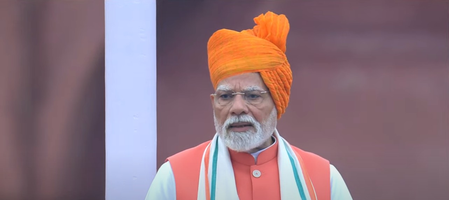
New Delhi, Aug 15: In a powerful Independence Day address from the ramparts of the Red Fort, Prime Minister Narendra Modi sent a stern message to Pakistan, declaring that India will no longer tolerate nuclear blackmail.
“Blood and water won’t flow together,” he said, referencing the Indus Waters Treaty and the country’s firm stance against cross-border terrorism.
Marking his 12th consecutive Independence Day speech, PM Modi’s remarks came amid heightened patriotic fervour as India celebrated its 79th year of freedom.
The Prime Minister hoisted the national flag and paid tribute to the Armed Forces, particularly for the success of Operation Sindoor, India’s military response to the April 22 Pahalgam terror attack.
PM Modi emphasised that India’s patience should not be mistaken for weakness. “India has decided it will not fall for nuclear threats anymore. Our Armed Forces have punished the masters of terror beyond their imagination,” he said, alluding to the deep strikes carried out under Operation Sindoor.
The Prime Minister also criticised the Indus Waters Treaty as “unjust and unreasonable,” suggesting that India may reconsider its obligations under the agreement if Pakistan continues to support terrorism.
His statement, “blood and water cannot flow together,” was widely interpreted as a warning of potential diplomatic and strategic recalibration.
The Red Fort ceremony was marked by symbolic gestures, including a floral tribute to Mahatma Gandhi and a dramatic aerial display by Indian Air Force helicopters showering petals over the venue.
One helicopter flew the national flag, while another carried a flag depicting Operation Sindoor, underscoring the mission’s national significance.
PM Modi’s speech also touched on the broader theme of Naya Bharat, reaffirming the government’s vision of a developed India –Viksit Bharat — by 2047.
“This festival of freedom is a festival of 140 crore resolutions,” he said, urging citizens to unite in building a stronger, self-reliant nation.
As India steps into its 80th year of independence, the message from Red Fort was clear: national security, sovereignty, and dignity will not be compromised.
On the occasion of the 79th Independence Day, Prime Minister NarendraModi declared Atmanirbhar Bharat as the bedrock of a Viksit Bharat by 2047, highlighting India’s strides in defence, technology, space, energy, manufacturing, and healthcare.
Addressing the nation from the Red Fort, the Prime Minister cited Operation Sindoor as a testament to India’s defence self-reliance, emphasising that indigenous capabilities empower the country to act decisively without foreign dependence.
He called for the domestic development of jet engines, semiconductor chips by year-end, and leadership in AI, cybersecurity, and deep-tech innovation.
Honouring tradition and strengthening defence, PM Modi announced the launch of ‘Mission Sudarshan Chakra’, aimed at neutralising enemy defence infiltrations and enhancing India’s offensive capabilities.
He linked the mission to the legendary Shri Krishna’s Sudarshan Chakra, highlighting how India draws inspiration from its rich cultural and mythological heritage to guide modern defence innovations. This mission underscores India’s commitment to strategic autonomy, ensuring rapid, precise, and powerful responses to any threat.
PM Modi also urged Indian innovators and youth to develop jet engines within India, ensuring that future defence technology is entirely home-grown and self-reliant.
In the space sector, PM Modi celebrated the achievements of Group Captain Shubhanshu Shukla and announced plans for India’s own space station.
He highlighted that over 300 startups are driving advances in satellites and exploration.
PM Modi said that to secure resources essential for energy, industry, and defence, India has launched the National Critical Minerals Mission, exploring 1,200 sites.
The PM highlighted that controlling these minerals strengthens strategic autonomy, ensuring India’s industrial and defence sectors remain self-reliant.
PM Modi also spoke about the National Deepwater Exploration Mission. He said India will harness its deepwater energy resources, strengthening energy self-reliance and reducing dependence on foreign fuel imports.
He announced private sector participation in nuclear energy and a plan to increase nuclear capacity tenfold by the centenary of independence.
Initiatives such as the National Critical Minerals Mission and National Deepwater Exploration Mission will secure vital resources and boost energy independence.
Agriculture self-reliance was underscored through domestic fertiliser production to protect farmers and food security.
PM Modi also urged the youth to develop indigenous social media platforms to safeguard digital sovereignty.
Reaffirming India’s role as the “pharmacy of the world”, he called for increased ‘Research and Development’ in medicines and vaccines, inspired by the country’s Covid-19 success.
He urged citizens to embrace the ‘Vocal for Local’ movement, promoting Swadeshi goods out of pride, not compulsion.
Highlighting ‘Operation Sindoor’, PM Modi said strategic autonomy and indigenous capabilities are key to decisively tackling threats, making self-reliance the bedrock of national strength, dignity, and the journey to a developed India by 2047.
Celebrating the remarkable achievements of Group Captain ShubhanshuShukla, PM Modi announced ambitious plans for India’s very own space station, signalling a new era of indigenous space capabilities. He highlighted that over 300 startups are actively innovating in satellites, exploration, and cutting-edge space technologies, ensuring that India is not just participating but leading globally in space science and exploration.
PM Modi stressed the importance of energy independence, saying that for the bright future of the nation’s youth and for welfare of farmers, this has to be done. He declared that while the world debated global warming, India had resolved to achieve 50 per cent clean energy by 2030, yet, thanks to the commitment of its people, that goal was met by 2025.

