

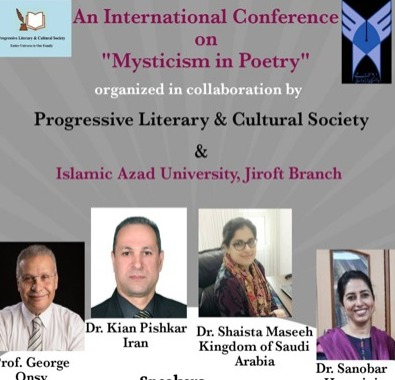
Srinagar: Progressive Literary & Cultural Society (PLCS), in collaboration with Islamic Azad University, Jiroft Branch Sunday organized an International E-Conference on “Mysticism in Poetry” on a virtual platform.
Dr. Shamenaz (Founder & President, PLCS) commenced the event by introducing the theme of the Conference, stating that “Mysticism, in its simplest form, is unification with God. Unlike religion, it is a practice but not an organized one. It lacks a prescribed method of prayer for attaining union with the Absolute, has no scripture, and no specific place designated for communion with God.”
She then introduced guest speakers from Egypt, Iran, Saudi Arabia, and India and subsequently invited them to deliver their lectures. The first speaker was Prof. George Onsy from Egypt. In his presentation, he discussed “Mysticism between East and West,” particularly focusing on Western Mysticism Literature and Western Metaphysical/Mystical Poetry and Poets. He emphasized the era of William Blake in England, his influence on other poets, his art, his poetry, and analysis of selected poems.
The next speaker, Dr. Kian Pishkar from Iran, highlighted mysticism in his speech, stating that mystic literature encompasses a diverse range of writings exploring the mystical, spiritual, and transcendent aspects of human experience.
He emphasized the inner journey, the quest for spiritual enlightenment, and the exploration of the divine or ultimate reality, which can be found in various cultural and religious contexts, each with unique characteristics and themes.
The third speaker, Dr. Shaista Maseeh from Saudi Arabia, spoke about the Indian mystic, Lal Ded. She mentioned, “Lal Ded is a revered figure not only in Kashmir’s spiritual and poetic circles but also in every household in the valley. She is respected by both Hindus and Muslims; Hindus call her ‘Lalleshvari,’ while Muslims refer to her as ‘Lal Arifa.’ This plural sensibility is a fine example of Kashmir’s cultural heritage, emphasizing the unity of the spiritual being transcending religious boundaries.”
The fourth speaker from India, Sanobar Hussaini, spoke on “Mysticism in Marsiya.” In her lecture, she explained that Marsiya allows for a deeply engaged experience, guiding believers (particularly Shiites) through lamentation into action and social movement. Initially derived from the Arabic ‘risa,’ marsiya was a short poem recited during funeral orations to express sorrow over a person’s death while praising the deceased. Over time, marsiya evolved to narrate the battle of Karbala, focusing on the martyrdom of Imam Husain, the grandson of Prophet Muhammad, and his companions in 60 A.H/679 A.D.
In the end, a Vote of Thanks was delivered by Prof. Shahnaz Khan from Govt. Science College, Pandhurna (M.P). On behalf of PLCS and Islamic Azad University, Jiroft Branch, Prof. S. Khan expressed heartfelt gratitude to the Chairperson, Dr. Shamenaz Sheikh, Prof. George Onsy, Dr. Kian Pishkar, Dr. Shaista Maseeh, and Dr. Sanobar Hussaini for their valuable contributions on Mysticism in Poetry. Their discussions highlighted mysticism as the oneness with God, portraying an inner journey of the soul to establish communion with the divine. Such conferences are imperative in the modern era, where the materialistic pursuit of worldly gains often fails to provide true happiness. These discussions remind us of the importance of spiritual happiness, attainable by focusing on the soul rather than the body.
The E-Conference was attended by professors, scholars, and students from India, Iran, Egypt, Saudi Arabia, Italy, and Uzbekistan.

